Desert Roses: Eternal Flowers of the Emptiness of Sand
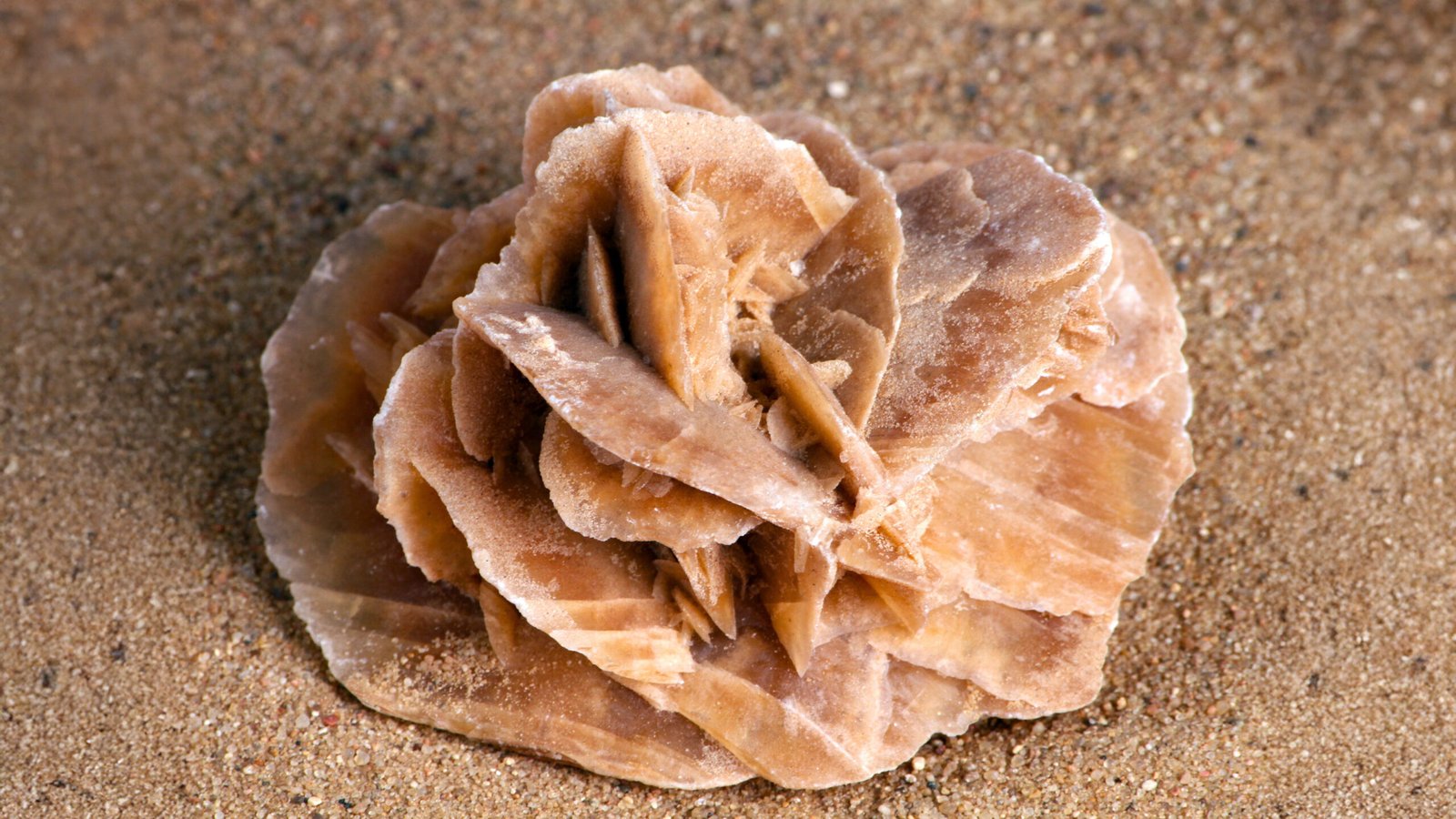
The desert pretends to be empty, but it’s lying. Beneath all that sand and silence, tiny dramas unfold, and some of them grow into shapes so strange you can’t decide whether nature is being poetic or sarcastic. Desert roses sit firmly in that category. They look like delicate flowers someone forgot to water for a decade, yet they’re solid mineral formations born not from life but from evaporation and stubborn chemistry. If the desert ever wrote its own love letter, it would probably look like one of these.
They start their story underground, where the world is calmer than the surface suggests. Water moves slowly through layers of sediment, picking up minerals along the way. In places where dryness rules the day, that mineral-rich water creeps upward and then disappears into thin air. The water leaves without apology. The minerals stay behind and begin organising themselves into crystals. Gypsum takes the lead most of the time, although barite occasionally steps in like an understudy hoping for more lines.
In perfect laboratory conditions, gypsum grows long, tidy crystals. The desert does not care about perfect conditions. Sand muscles its way into every space, interrupting the growth pattern and forcing the crystals to broaden into thin, flat blades. Those blades radiate outward like petals. This isn’t nature being whimsical. It’s nature dealing with constant interference and still managing to look elegant.
Once the crystals begin forming, everything depends on patience. Too much water melts the structure. Too little mineral content starves it. Sudden changes ruin the symmetry. The desert rose grows best in quiet, steady tension, which might explain why it looks so contemplative. It forms in dry lake beds, sabkhas, salt flats, and other places where the land has dried enough times to get good at the process.
Most desert roses never see daylight until the wind decides they’ve earned it. They sit just below the surface like buried trinkets, waiting for the surrounding sand to erode. Then they appear as if placed there intentionally, a visual reminder that the desert has better taste than it lets on. People often assume they were arranged for effect. They weren’t. The wind is simply an expert curator.
Colours rarely wander far from the desert’s natural palette—creams, beiges, dusty browns, and occasional blushes of pink or rust. Barite roses tend to be darker and much heavier than you expect. Gypsum versions look soft but scratch with a fingernail. And yet, when you hold one, you feel none of the fragility you’d associate with a bloom. Instead, it feels cool and grounded, like a whispered secret that learned to harden over time.
The places where desert roses appear read like a travel itinerary for people who enjoy heatstroke. Morocco and Tunisia produce some of the finest specimens. Saudi Arabia and the broader Arabian Peninsula also play host. Parts of Australia join in, along with Spain, Mexico, and the southern United States. Oklahoma’s barite roses became so iconic the state declared them official—proof that even governments occasionally indulge in geological romance.
Their size varies in ways that seem intentionally dramatic. Some fit into a pocket. Others sprawl across a table like mineral architecture. Smaller roses might form over decades, while the larger, more intricate ones quietly accumulate over centuries. Humans complain when the kettle takes too long to boil. Desert roses simply wait.
Their survival relies on one rule: avoid water. Gypsum dissolves slowly, which means humidity, rain, and well-meaning attempts to clean them all cause harm. Museums know this and treat them like temperamental art pieces. The best care they can receive is gentle dusting and a promise never to be washed.
Because humans love symbolism almost as much as they love minerals that look like flowers, desert roses acquired a reputation for resilience. They represent endurance, transformation, and beauty born from challenging conditions. People display them on shelves to suggest they too are unbothered by adversity—even if the air conditioning is on.
Alongside the admiration come the myths. Desert roses are not fossilised plants. They are not remnants of ancient flowers, nor are they carved. They also do not grow from seeds, despite enthusiastic claims from gift-shop staff in various corners of the world. And the idea that perfectly shaped specimens must be artificial? Entirely wrong. Nature, given time and silence, can outperform any sculptor.
That said, the market has its share of enhanced or reassembled specimens. Large, theatrical roses occasionally turn out to be geological patchworks held together by glue. Most people don’t spot the difference, but collectors check for continuous crystal growth, natural texture, and weight. Gravity, at least, refuses to lie.
For geologists, desert roses are more than decorative curiosities. They preserve clues about past climate conditions—evaporation rates, sediment chemistry, mineral concentrations, and even subtle changes in groundwater movement. Each formation is a small, stubborn archive carved from dryness.
Their photographic personality is another story entirely. They look soft in images but are anything but. Lighting makes or breaks them. Harsh light erases depth. Overly crisp shadows turn them into props. Soft, directional light reveals the layering that gives them character. A macro lens transforms them into alien landscapes where the viewer forgets how big—or small—they truly are.
Designers love them precisely because they behave like sculptures without the weight of grand statements. They sit comfortably next to linen, concrete, wood, or ceramics, they don’t clash with interiors, they don’t demand attention. And they just exist with quiet confidence, the visual equivalent of someone who knows the dress code without asking.
This gives desert roses a strangely modern appeal. They parallel the idea that constraint breeds creativity, that beauty appears not from luxury but from limitation. Humans rarely think of evaporation as an artistic force, yet here it sculpts flowers out of minerals, reminding us that subtraction has its own aesthetics.
Pick up a desert rose and for a brief moment you feel the desert captured in your hand—not its heat or harshness, but its quiet ability to make something unexpectedly beautiful under pressure. The rose never tried to bloom. It simply endured until its form emerged. It is the patience of the landscape made visible, a reminder that emptiness is often just the beginning of a different story.