Daeodon: Power, Omnivory, and the Myth of the “Hell Pig”
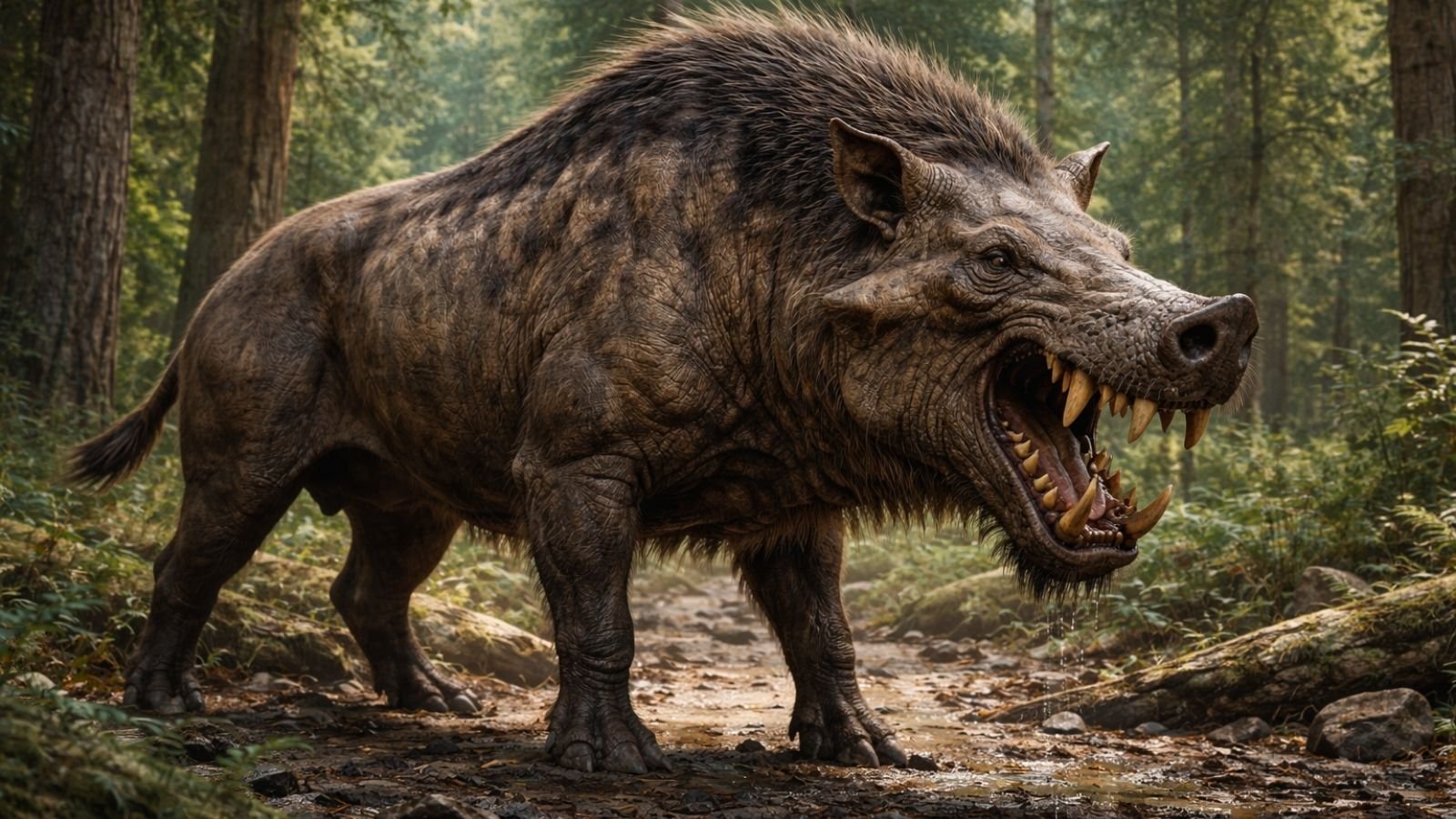
Daeodon never asked to be subtle. It arrived late in the Miocene with a skull the size of a suitcase, cheekbones flared like armour plating, and a jaw built to test the patience of physics. Millions of years later, it still inspires the same reaction: people look at it and immediately decide it must have been a nightmare made of teeth. That assumption says more about us than it does about the animal.
Long before internet nicknames flattened it into a meme, Daeodon occupied a complicated ecological role. North America between seven and five million years ago did not resemble the romantic grassland postcards we like to imagine. It was a patchwork of open plains, wooded corridors, seasonal water sources, and long distances between reliable meals. Survival rewarded flexibility rather than elegance. Daeodon embodied that logic perfectly.
Its family, the entelodonts, had already been around for tens of millions of years by the time Daeodon appeared. They were not evolutionary accidents or short-lived oddities. They spread across Eurasia and North America, diversified into multiple forms, and adapted repeatedly to shifting climates. Daeodon represented the largest and latest expression of that experiment, not its beginning.
Calling it a pig does everyone a disservice. The label sticks because the skull looks vaguely porcine and because people enjoy the idea of a monstrous hog roaming prehistoric plains. In reality, entelodonts sit on a broader branch of the mammal family tree that includes pigs, hippos, and, through deep evolutionary twists, whales. That alone should complicate the mental picture. Daeodon was not a failed pig. It was something else entirely.
Size did much of the talking. Estimates vary, but most reconstructions place Daeodon at close to a tonne in weight, standing roughly as tall at the shoulder as a large horse. Lengthwise, it could stretch beyond three and a half metres. That mass did not sit on stumpy legs either. Its limbs were long, relatively straight, and built for covering ground efficiently. This was an animal designed to arrive, not to sprint.
The skull dominates every discussion for good reason. Nearly a metre long in some specimens, it combined crushing molars with slicing teeth and forward-facing canines that could intimidate before they ever bit. The bone itself was unusually thick in key areas. Those flared cheekbones were not decorative accidents. They likely served as shock absorbers during head-to-head clashes, much like the reinforced skulls of some modern animals that settle disputes with impact rather than pursuit.
That detail shifts how Daeodon should be imagined. Popular art often turns it into a relentless predator, jaws open, blood everywhere. The anatomy tells a quieter but more realistic story. This was an animal that relied on presence. It did not need to chase everything. Often, it only needed to show up.
Diet remains one of the most argued points, largely because people want a simple answer. Carnivore or herbivore. Hunter or scavenger. Daeodon refused that binary. Its teeth handled a wide range of tasks. It could process tough plant material, crush bone, strip meat, and break down whatever it found worth eating. Isotopic evidence and wear patterns point firmly toward omnivory, but not the gentle kind.
Imagine a carcass on the Miocene plains. Smaller predators arrive first. They feed quickly, nervously. Then something large appears on the horizon. It does not rush. It walks. At some point, the calculation changes. Teeth and speed matter less than mass and confidence. Daeodon likely excelled at that moment. It did not invent scavenging, but it professionalised it.
That does not mean it never hunted. Opportunistic killing makes sense for an animal of its build. Young, injured, or slow prey would have been fair game. What it almost certainly did not do was specialise in bringing down large, healthy animals through endurance chases. The legs suggest movement, not pursuit. The teeth suggest versatility, not finesse.
Aggression appears mostly reserved for its own kind. Fossils tell a surprisingly personal story here. Some entelodont bones carry bite marks that match entelodont teeth. The placement of those injuries aligns more with fighting than feeding. Add the reinforced skull and facial bosses, and a picture emerges of violent intraspecies competition. Territory, mates, access to resources. These disputes likely ended quickly and decisively.
Social behaviour remains speculative, but comparisons help. Bears provide a useful modern analogue. Solitary most of the time, temporarily tolerant when food concentrates, and capable of explosive aggression when boundaries are crossed. A fully grown Daeodon probably lived alone by default and tolerated others only when the landscape forced proximity.
The world it inhabited was crowded with impressive animals. Early horses grazed in growing numbers. Camels, still native to North America at the time, browsed alongside them. Rhinoceroses wandered the same corridors. Predators included saber-toothed cats and the last of the bear-dogs, animals that blended canine endurance with ursine bulk. Competition was real and constant.
In that environment, Daeodon filled a role few others could. It dealt in leftovers that others could not process. Bone, cartilage, tough plant matter. That ability mattered. Ecosystems rely on clean-up crews as much as hunters. Removing waste, recycling nutrients, and preventing disease all shape long-term stability. Daeodon likely contributed quietly and efficiently.
Its reputation suffered later. The nickname “hell pig” says more about human storytelling than scientific insight. It compresses complexity into shock value. The skull looks intimidating, so the animal must have been monstrous. That logic appears repeatedly in palaeontology, especially when animals lack modern analogues that feel comforting.
Artists and popular writers often place Daeodon in swamps or dark forests, amplifying the horror aesthetic. Geological and fossil evidence points instead to open landscapes with room to move. Seeing it under a wide sky rather than dripping from shadows changes the tone entirely. It becomes less of a jump scare and more of a force of nature.
Several controversies remain unresolved. Weight estimates swing widely depending on whether researchers prioritise limb proportions, skull size, or comparisons with modern mammals. Some reconstructions push it beyond a tonne. Others stay more conservative. The truth likely varied between individuals, sexes, and local conditions.
Sexual dimorphism itself remains debated. The facial bosses may have differed between males and females, but fossil samples remain too limited to say with confidence. If males carried larger bosses, that would strengthen the case for visual display and ritualised combat rather than constant lethal aggression.
Extinction poses another unanswered question. Daeodon disappeared near the end of the Miocene, as climates cooled and ecosystems shifted. Grasslands expanded. Faunal communities reorganised. New predators emerged. It may have lost its niche gradually rather than catastrophically. Large generalists sometimes struggle when systems reward speed and specialisation.
What makes Daeodon fascinating today is not how terrifying it looks, but how well it illustrates a forgotten strategy. Power without specialisation. Dominance without speed. Success built on adaptability rather than elegance. Modern ecosystems still rely on similar figures, even if they wear softer faces.
The skull still draws crowds in museums. People stop, stare, and instinctively recoil. That reaction feels ancient and appropriate. Daeodon would have wanted that pause. In life, hesitation created opportunity. In death, it creates curiosity.
Understanding Daeodon requires resisting the urge to flatten it into a villain. It was not a monster roaming aimlessly. It was a solution to a specific time and place. When that place changed, the solution no longer worked. That is not failure. That is evolution doing what it always does.
Seen clearly, Daeodon becomes less frightening and more impressive. It represents a reminder that dominance comes in many forms, and that nature rarely builds anything without purpose, even when the result unsettles us millions of years later.