Concorde: When Supersonic Travel Became Normal, Briefly
On a cold January morning in 1976, speed officially entered the timetable. Not metaphorical speed, not aspirational speed, but the kind that bent physics, irritated governments, and left airport departure boards struggling to keep up. That morning, Concorde did not slip quietly into service. Instead, it arrived already famous, already controversial, already carrying more symbolism than most aircraft manage in a lifetime.
This was not the maiden flight. That moment had happened years earlier, watched by engineers, politicians, and journalists armed with notebooks full of superlatives. What made this day different was risk. Selling tickets meant responsibility. It meant schedules, passengers, expectations, and the possibility of failure played out in public.
On 21 January 1976, Concorde began regular commercial operations. Two flights departed almost simultaneously, one operated by British Airways and the other by Air France. Notably, they did not fly to New York. That celebrated route would come later. Instead, the first paying passengers travelled from London to Bahrain and from Paris to Rio de Janeiro via Dakar.
Those destinations were not romantic accidents. They were shaped by politics, noise regulations, and a growing discomfort with speed passing overhead. Supersonic flight needed somewhere to go, and not everyone wanted it passing above their homes.
The idea behind Concorde had taken shape in a very different world. During the late 1950s and early 1960s, speed looked like destiny. Jet aircraft had already collapsed oceans into manageable distances. Military aviation pushed relentlessly beyond the sound barrier. Meanwhile, space programmes promised the Moon and beyond. Against that backdrop, a supersonic passenger aircraft felt less like a gamble and more like the obvious next step.
Britain and France decided to build it together, not because airlines demanded it, but because governments wanted it to exist. Concorde became a political object as much as an engineering one. It signalled European competence, technological independence, and a refusal to concede prestige to the United States or the Soviet Union. At that stage, cost mattered less than symbolism.
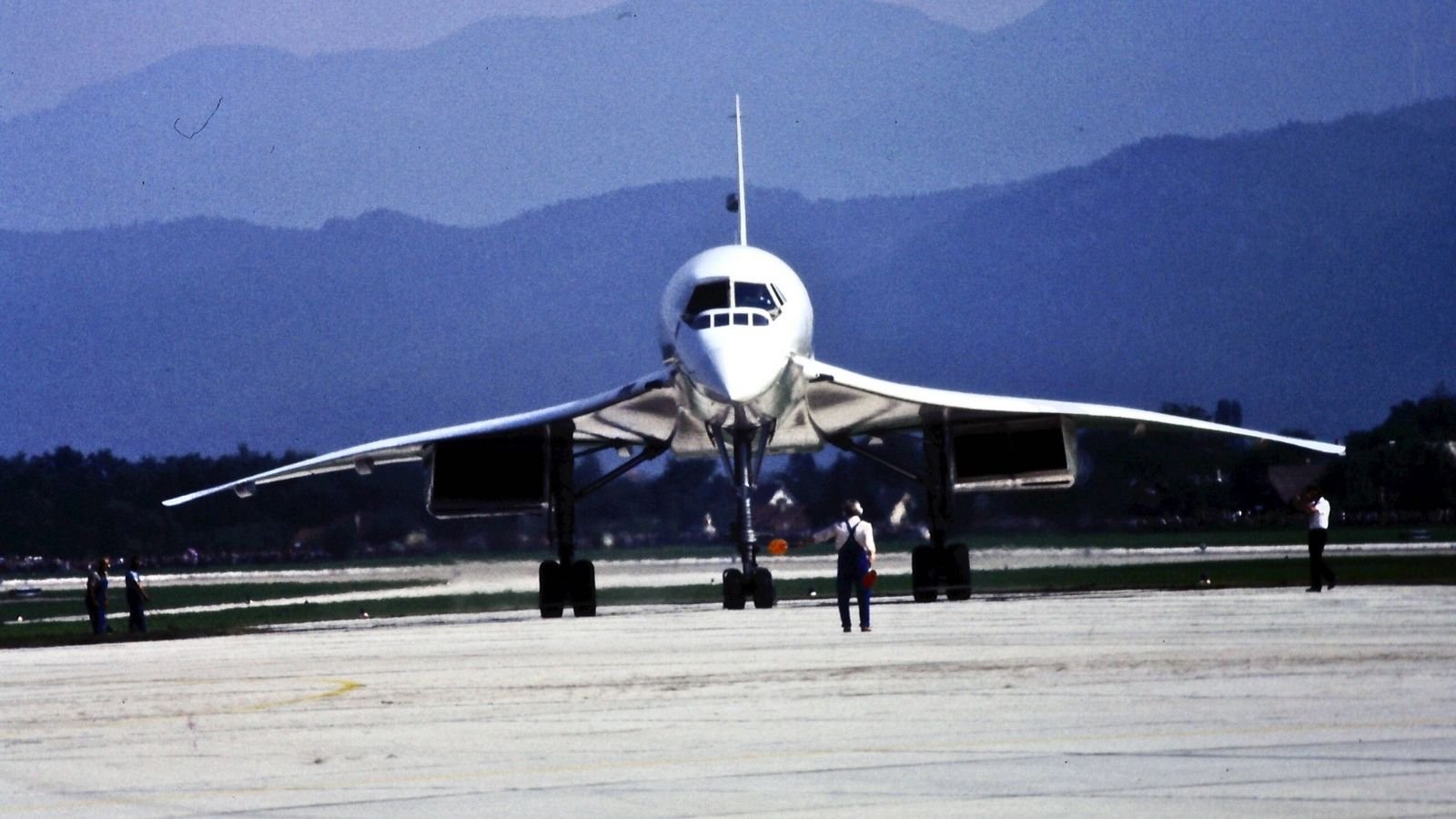
The aircraft that emerged looked unlike anything else on the tarmac. Long, narrow, and unapologetically sharp, it appeared designed to slice rather than lift. Its delta wing stretched wide and thin. Its nose drooped theatrically for take-off and landing. Meanwhile, its engines sat tightly integrated into the wing, optimised for sustained supersonic cruise rather than efficiency at lower speeds.
Every element of Concorde involved compromise. It sacrificed fuel economy for velocity. It traded passenger capacity for aerodynamic purity. Complexity replaced simplicity in the pursuit of performance. Even comfort slipped down the list. The cabin remained narrow. The windows stayed small. Storage space felt optimistic at best. Passengers did not board Concorde for legroom. They boarded for time.
At cruise, the aircraft flew at around Mach 2.02, more than twice the speed of sound. It climbed to roughly 60,000 feet, well above conventional air traffic and most weather systems. As a result, the sky darkened noticeably at that altitude, shifting from pale blue to something closer to indigo. On clear days, the curvature of the Earth became visible, a subtle but unsettling reminder of scale.
Speed also brought heat. Friction with the air raised the temperature of the aircraft’s skin dramatically. Over the course of a flight, Concorde lengthened by up to 25 centimetres as metal expanded. Engineers anticipated this behaviour. Sliding joints absorbed the movement. Inside the cabin, passengers sometimes heard gentle creaks as the structure negotiated with physics.
Sound followed behind.
Breaking the sound barrier produced a sonic boom, a shockwave that travelled all the way to the ground. Military pilots accepted it as routine. Civilians did not. To people underneath, it arrived as a sudden, rolling thunderclap, often without warning. Windows rattled. Animals panicked. Complaints accumulated quickly.
Unsurprisingly, the sonic boom became Concorde’s greatest limitation. Supersonic flight over land triggered public backlash and political resistance. Consequently, Concorde could only exceed Mach 1 over the sea. Over populated areas, it had to slow down, instantly losing the advantage it existed to provide.
That single constraint reshaped everything. Routes needed to be transoceanic or diplomatically negotiated. Entire continents effectively closed themselves to routine supersonic travel. The aircraft designed to shrink the world found itself confined by it.
When Concorde finally entered commercial service in 1976, the world had already shifted. The oil crisis of 1973 had redrawn economic priorities. Fuel prices soared. Efficiency became fashionable. Environmental concerns gained traction. Concorde, conceived in an era of optimism, arrived during an age of doubt.
Critics were waiting. Environmental groups attacked its noise and emissions. Economists questioned its cost. American politicians resisted its presence. Lawsuits and protests delayed approvals for US airports. For months, Concorde circled the Atlantic like a guest not yet invited inside.
That context explains why the first commercial flights avoided New York. Bahrain and Rio de Janeiro offered fewer legal obstacles and greater diplomatic flexibility. At the same time, they allowed Concorde to demonstrate its core promise without immediately provoking its loudest opponents.
Those first passengers knew they were part of something unusual. Flying Concorde felt different before departure. Security moved faster. Boarding felt ceremonial. Cabin crew treated the experience as theatre as much as transport. Champagne appeared early. Meals arrived quickly, designed to fit compressed schedules.
Time behaved strangely onboard. On transatlantic flights, passengers could eat breakfast, lunch, and still arrive before their departure time according to local clocks. Traders joked about earning money while flying west. Executives scheduled meetings on landing that would have been impossible the same morning by subsonic aircraft.
Over time, British Airways realised that Concorde worked best when framed as a luxury time machine rather than a plane. Ticket prices climbed steeply. Return fares reached several times the cost of first class on conventional jets. Yet demand held, not from the masses, but from a narrow slice of people who valued hours more than money.
Celebrities embraced it. Heads of state relied on it. Financial professionals turned it into a commuter tool. Concorde became shorthand for a particular kind of confidence, one that assumed the future could be bent with enough engineering and enough cash.
Despite popular myth, Concorde was not always a financial catastrophe. Once development costs were written off, British Airways managed to operate it profitably by the late 1980s and 1990s. Air France was less aggressive in pricing. Nevertheless, both airlines kept the aircraft flying far longer than early critics predicted.
Safety, often questioned, remained strong for most of its career. Concorde logged tens of thousands of flights with remarkably few incidents. The aircraft was overengineered, meticulously maintained, and flown by specially trained crews. Its reputation suffered far more from perception than from statistics.
That perception shifted abruptly in 2000.
The crash near Paris during take-off marked Concorde’s only fatal accident. Investigators traced the cause to debris on the runway that ruptured a tyre, triggered a fuel leak, and ignited a chain of failures. Although the underlying issue involved runway maintenance rather than a fundamental design flaw, confidence fractured overnight.
After a temporary return to service, Concorde never fully recovered. September 11 reshaped aviation economics. Maintenance costs rose. Fleets aged. Political enthusiasm faded. In 2003, Concorde flew its final commercial passengers and exited history the same way it entered it, surrounded by cameras.
Looking back at that first commercial flight in 1976, what stands out is intent rather than nostalgia. Concorde represented a belief that progress meant faster, louder, and more dramatic. It assumed society would adapt to technology rather than the other way around.
That assumption no longer holds so easily.
Modern aviation prioritises efficiency, sustainability, and scale. Aircraft grow quieter and more fuel-conscious. Supersonic passenger travel remains technically possible, but politically and economically awkward. New projects promise quieter sonic booms and cleaner fuels. Still, none have crossed the threshold Concorde did.
For nearly three decades, Concorde proved that supersonic travel could be routine rather than experimental. It normalised the extraordinary. It sold speed as a product. And it reminded the world that time itself could be negotiated, at least for those who could afford the ticket.
The first commercial Concorde flight remains a marker rather than a relic. It shows what happens when ambition outruns caution, when engineering answers questions society has not yet agreed to ask. Whether it represents a future paused or a path wisely abandoned remains unresolved.
What is certain is this: on that January day in 1976, speed stopped being theoretical. It checked in, boarded early, and went supersonic.