Clay, Reed, and Wedges: The Simple Cuneiform Writing Tools
Clay rarely attracts admiration. It lies quietly along riverbanks, soft, grey, and unimpressive. Yet in ancient Mesopotamia this ordinary mud supported one of humanity’s most practical inventions: writing things down so nobody could dispute them later.
Across the lands between the Tigris and Euphrates, administrators, merchants, priests, and kings all relied on a surprisingly simple toolkit. A lump of clay. A trimmed reed. A patient hand. Together these humble cuneiform writing tools created bureaucracies, preserved myths, recorded taxes, and occasionally exposed unpaid debts.
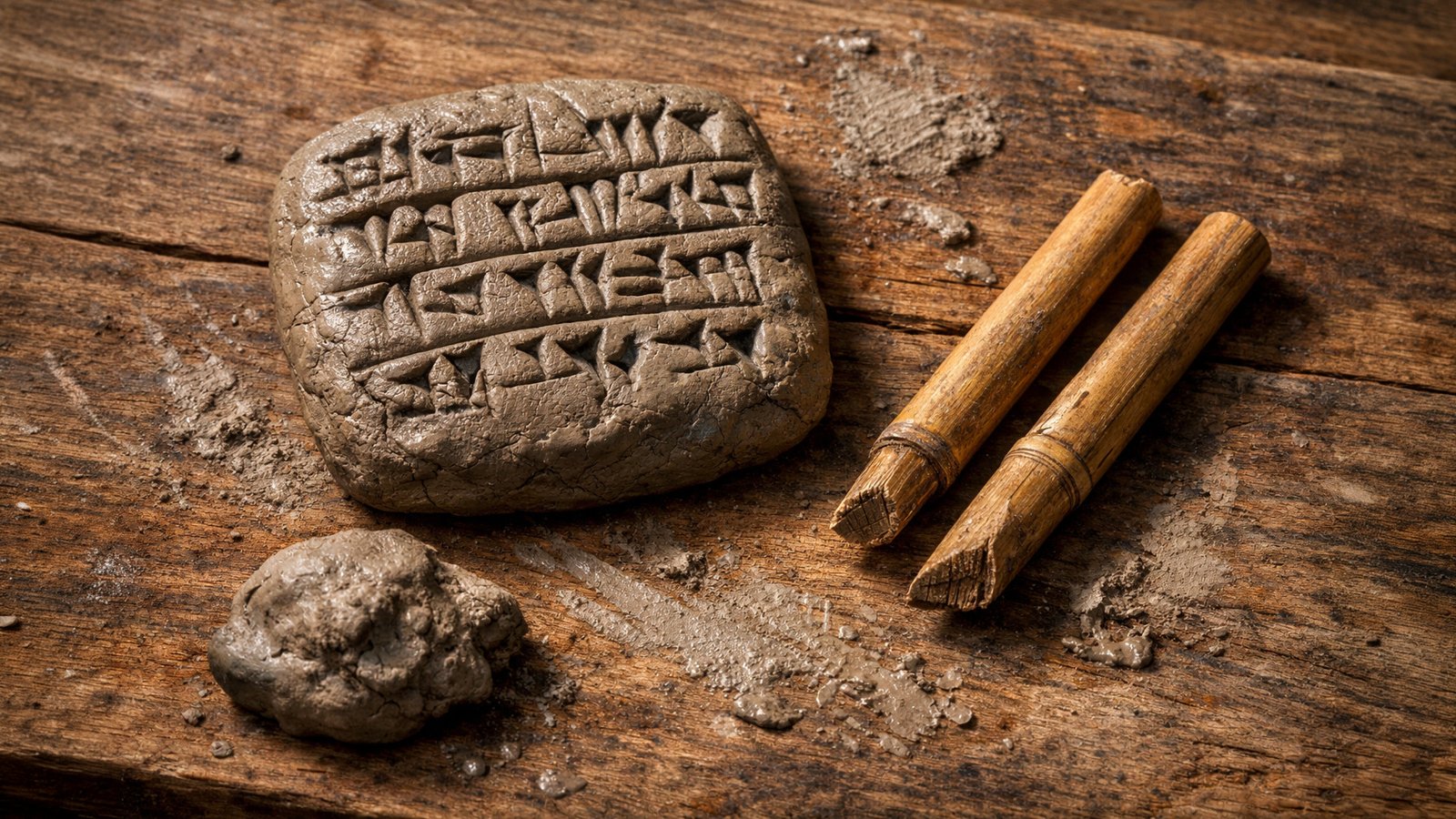
First came the clay. Scribes gathered fine river mud and kneaded it carefully, much like dough in a bakery. Pebbles had to disappear because even a small grain of grit could distort a line of text. Once the clay became smooth and pliable, the scribe shaped it into a tablet.
Some tablets remained small enough to rest easily in a palm. These served everyday administrative tasks such as counting grain sacks or listing sheep. Larger tablets, however, carried literature, royal announcements, or detailed scholarly texts. Consequently, the physical size often revealed the importance of the message.
A fresh tablet felt cool and slightly heavy. At the same time the surface had to remain firm enough to hold impressions. If the clay stayed too wet, the marks collapsed. If it dried too quickly, the stylus left faint scratches instead of clear wedges. Therefore experienced scribes learned to judge moisture with remarkable precision.
Next entered the second tool in the cuneiform writing toolkit: the reed stylus. Tall reeds grew abundantly along Mesopotamian waterways. Because the plant was hollow yet sturdy, it proved ideal for shaping into writing tools. Scribes cut short sections of reed and trimmed the tip at an angle.
The finished stylus resembled a tiny wedge rather than a pen. Instead of drawing lines, the scribe pressed the stylus into the clay surface. Each press left a triangular mark. Gradually these marks formed the distinctive patterns now recognised as cuneiform signs.
The name itself reflects this shape. The word cuneiform comes from the Latin term for wedge. Every character consists of small wedge impressions arranged carefully in different directions. Horizontal wedges appear beside vertical ones, while diagonal marks fill the spaces between them.
Writing therefore looked less like sketching and more like controlled tapping. The stylus pressed downward, lifted, rotated slightly, then pressed again. Slowly the tablet filled with rows of tiny arrowhead shapes marching across the clay.
Early writing in Mesopotamia looked quite different. The earliest tablets used pictograms, small drawings representing objects. A jar looked roughly like a jar. A fish resembled a fish. However curved drawings proved awkward to carve into damp clay.
Because the reed stylus naturally created triangular impressions, scribes gradually simplified these pictures. Over time the drawings transformed into clusters of wedges. As a result writing became faster, cleaner, and easier to repeat.
Efficiency drove the change. Instead of sketching a sheep each time, a scribe could stamp a compact sign that everyone understood as sheep. Practicality, rather than artistic ambition, shaped the appearance of the script.
Holding the tablet required practice as well. Many scribes supported the clay with one hand while writing with the other. Since the stylus pressed rather than dragged, the wrist moved in short, deliberate motions. Consequently the technique resembled careful stamping instead of flowing handwriting.
Each sign required multiple impressions. A complex character might contain ten or more wedges placed in precise angles. Consistency mattered greatly. If a wedge sat too shallow, the sign became unclear. If it went too deep, the clay distorted.
For that reason scribal education lasted years. Students studied in institutions known as edubba, literally houses of tablets. There they copied sign lists repeatedly until their hands learned the rhythm of pressing wedges into clay.
Training tablets reveal this routine vividly. One side often contains neat rows written by the teacher. Meanwhile the reverse side shows the student’s attempt to copy the same lines. Corrections sometimes appear between the wedges, gently reminding the apprentice to improve.
Nevertheless mistakes happened frequently. Fortunately clay offered a forgiving advantage. If the error appeared early, the scribe simply smoothed the surface and tried again. In that sense the tablet functioned like a reusable notebook.
Once the text finished, however, the clay began to dry. From that moment the words became far less flexible. A dried tablet preserved its message whether convenient or embarrassing.
Tablet shapes varied widely depending on purpose. Small administrative tablets dominated daily business. These recorded deliveries of barley, numbers of livestock, and assignments of labourers. Consequently city archives accumulated thousands of such documents.
Larger tablets served literature and scholarship. Myths, hymns, medical observations, and mathematical calculations filled broader surfaces divided into columns. Readers rotated the tablet slightly while reading lines from left to right.
Storage created its own practical challenge. Clay objects stack differently from paper pages. Therefore archives stored tablets in baskets, wooden shelves, or clay containers. Many tablets even carried short labels on their edges so archivists could recognise the contents quickly.
In addition scribes sometimes added colophons at the end of a text. These notes recorded the name of the copyist or the position of the tablet within a longer series. The system resembles a catalogue entry surprisingly familiar to modern librarians.
Among the most curious tools in Mesopotamian administration was the clay envelope. Important contracts occasionally travelled inside protective shells of clay. First the scribe wrote the agreement on a tablet. Afterwards a thin layer of fresh clay wrapped around the tablet completely.
The scribe then wrote the same text again on the outer surface. If disagreement later arose, officials broke open the envelope and compared the inner tablet with the outer copy. Any alteration would become obvious immediately. Thus ancient bureaucracy invented a tamper‑evident security system thousands of years before modern packaging.
Durability posed another decision. Not every message required permanence. Temporary notes often dried naturally in the sun. If the clay was needed again, soaking the tablet softened it back into workable mud.
Important records followed a different path. Officials baked those tablets in kilns until the clay hardened into ceramic. Consequently the text could survive centuries, sometimes millennia.
Ironically many tablets reached modern museums through disaster. Fires that destroyed palaces or temples often baked entire archives accidentally. While buildings vanished, the tablets endured.
Today collections around the world hold tens of thousands of these objects. Many still display crisp wedge marks pressed by scribes thousands of years ago. The clarity can feel astonishing.
The stylus itself rarely survives because reeds decay quickly. Therefore archaeologists study the impressions left in the clay to reconstruct cuneiform writing tools. Each wedge reveals the pressure, angle, and shape of the stylus tip.
Experimental archaeologists have even recreated reed styluses to test ancient techniques. By pressing replicas into clay they observe how different cuts produce different wedge shapes. As a result researchers now understand the writing process far better than before.
These experiments demonstrate how efficient the system was. A trained scribe could record information rapidly using short, repetitive movements. Consequently even small tablets sometimes hold dozens of lines of text.
Languages across the ancient Near East eventually adopted this writing system. Sumerian used it first. Later Akkadian, Babylonian, Assyrian, Hittite, and several other languages adapted the same wedge marks to represent their own sounds.
Over centuries scribes standardised hundreds of signs into consistent patterns. Learning them required patience and discipline. Therefore scribes occupied an important social position as educated specialists.
Kings relied on them to issue decrees. Merchants depended on them to record trade. Temples needed them to manage offerings and land. In many ways the entire administrative machinery of Mesopotamian cities rested on clay tablets.
Remarkably all of this depended on the simplest materials imaginable. Clay gathered from a riverbank. A reed trimmed into a stylus. Human patience guiding both tools.
Consider the elegance of the system. No ink bottles, no parchment sheets, no metal pens. Instead the landscape itself supplied everything necessary for writing.
Yet these modest cuneiform writing tools preserved extraordinary knowledge. Law codes, diplomatic letters, astronomical observations, recipes, and medical treatments all appear on clay tablets. The range of subjects feels surprisingly modern.
Administrative records reveal everyday life as well. Some tablets track barley rations for workers. Others list sheep belonging to temple herds. Meanwhile merchants recorded shipments of copper, wool, or timber arriving from distant regions.
Occasionally the tone becomes personal. A student complains about strict teachers. A merchant argues about missing cargo. A farmer reports the stubborn behaviour of goats. Through these wedges ancient voices still speak.
Behind every impression stood a person pressing a reed into soft clay while completing the day’s paperwork. The moment lasted only seconds, yet the mark remained for millennia.
The physical experience must have been distinctive. Fingers touched cool clay. The stylus tapped gently again and again. Rows of wedges slowly organised themselves into meaningful patterns.
When the tablet dried, that moment froze permanently. Centuries later archaeologists could still read the same words.
Clay therefore proved unexpectedly durable. Paper burns easily and ink fades with time. Fired clay, however, becomes extremely resilient. Consequently libraries of Mesopotamian tablets survived long after their cities disappeared.
The famous library assembled by the Assyrian king Ashurbanipal demonstrates this durability vividly. Tens of thousands of tablets once filled its rooms. They contained mythology, science, medicine, and state correspondence.
Every tablet began exactly the same way. A piece of river clay shaped by careful hands. A reed stylus cut from marsh plants. Then a sequence of small wedge impressions forming words.
Although the marks may appear mysterious today, their origin remains refreshingly practical. Scribes simply needed a reliable method to record information quickly. The reed stylus pressing wedges into clay solved that problem elegantly.
Press, lift, rotate, press again. The rhythm repeated countless times across countless tablets. From these modest tools grew one of the longest‑lasting writing traditions in human history.
Post Comment
You must be logged in to post a comment.