Chinese New Year 2026. The Year of The Fire Horse
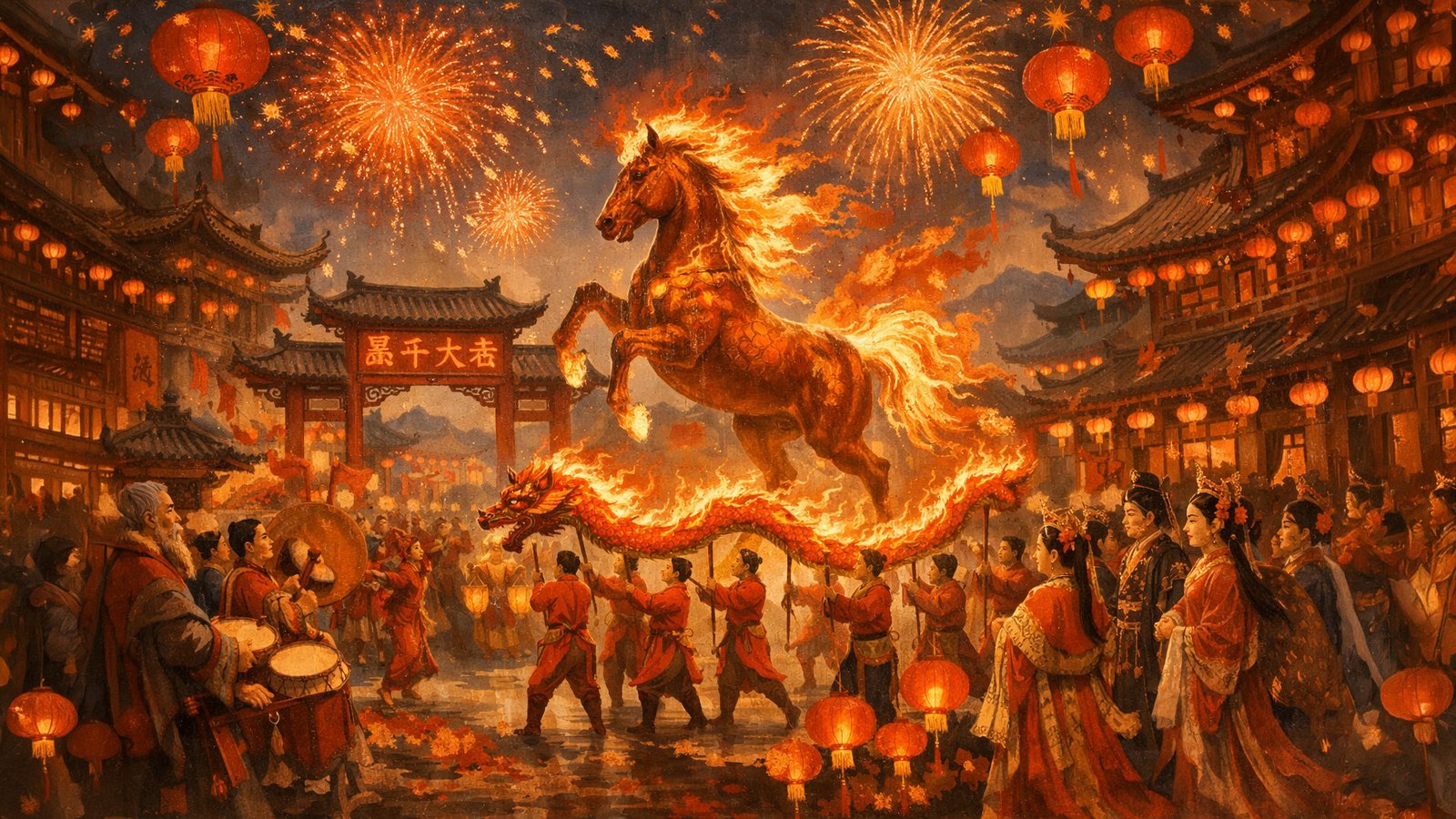
There’s something rather brilliant about a festival that involves scaring off a mythical beast with loud noises, wearing your luckiest red socks, and eating dumplings with secret coins hidden inside. Welcome to Chinese New Year, where ancient traditions meet modern celebrations in what’s become one of the planet’s most spectacular annual events.
For over two billion people worldwide, Chinese New Year isn’t just another date on the calendar. Rather, it’s the moment when families reunite across impossible distances, when the colour red transforms entire cities, and when the largest human migration on Earth takes place. In 2026, festivities kick off on 17th February, ushering in the Year of the Fire Horse with all the energy, passion, and restlessness that comes with it.
But here’s what makes this celebration truly fascinating: beneath all the fireworks and dragon dances lies a rich tapestry of myths, superstitions, and traditions that have evolved over thousands of years. Some customs have remained remarkably unchanged since the Han dynasty, whilst others have adapted brilliantly to modern life. After all, these days you can receive your red envelope via WeChat, though the symbolism remains exactly the same.
Let’s start with the beast that started it all. According to legend, a terrifying monster called Nian once terrorised villages every year. Sporting a lion’s head, a bull’s body, and a unicorn’s horn, this creature would emerge from either the sea or mountains on New Year’s Eve to devour livestock, crops, and the occasional unfortunate villager. Understandably, people lived in absolute terror of this annual visit.
Eventually, however, the villagers discovered Nian’s three critical weaknesses: the colour red, loud noises, and bright lights. One version of the tale involves a mysterious old beggar who revealed this secret after being offered dumplings by a kind-hearted woman. When the villagers returned from hiding in the mountains, they found their homes intact, decorated with red paper and the remains of firecrackers still crackling in the courtyards. Thus began a tradition that’s lasted millennia.
Consequently, this is why everything turns gloriously, vibrantly red during Chinese New Year. Red lanterns swing from buildings, red couplets adorn doorways, and red clothing fills wardrobe shops. Nevertheless, it’s not just about aesthetics, though the effect is genuinely stunning. Red symbolises luck, prosperity, and happiness whilst simultaneously warding off evil spirits and bad fortune. If you’re planning to celebrate, black and white are strictly off-limits as they’re associated with mourning.
The word “Guo Nian” perfectly captures this origin story. Literally meaning “pass over Nian” or “overcome Nian,” it’s what Chinese people call the act of celebrating New Year. Rather marvellously, the character for “year” itself is “Nian,” connecting the monster to the very concept of annual cycles. Yet here’s an intriguing controversy: historians have found no ancient texts mentioning the Nian beast before the early 20th century. Written sources referring to Nian as a creature date only to that period, raising questions about whether this beloved legend is truly ancient or perhaps a more recent folk tradition finally recorded in writing.
Nevertheless, the traditions inspired by Nian have become integral to celebrations worldwide. Firecrackers explode at midnight, sending evil spirits scattering alongside any hope of a peaceful night’s sleep. Moreover, families stay up late practising “Shou Sui,” traditionally remaining awake all night though nowadays most people simply wait until after midnight’s fireworks subside.
Speaking of traditions, let’s talk about the preparations. Roughly a week before New Year’s Eve, Chinese households undergo a transformation that would make Marie Kondo proud. Every surface gets scrubbed, every corner swept, every window polished. Mind you, this isn’t mere spring cleaning. Rather, it’s a symbolic sweeping away of the previous year’s bad luck to make room for incoming good fortune.
However, once New Year’s Day arrives, put those brooms away. Sweeping on the first day is considered extremely unlucky as you’d literally be brushing away all that lovely new good fortune you’ve just invited in. In some regions, people won’t touch a broom until the fourth or fifth day. Additionally, using knives or sharp objects is discouraged, washing your hair is frowned upon, and breaking anything is particularly catastrophic. If you do accidentally smash a plate, quickly wrap the pieces in red paper and mutter “Sui Sui Ping An” (the words for “year” and “broken” sound similar, so saying them together supposedly expels bad luck).
Then there’s the Kitchen God, who requires special attention. On the 23rd day of the last lunar month, this deity ascends to heaven to report on each family’s behaviour to the Jade Emperor. Naturally, families want a glowing review, so they offer the Kitchen God sweet sticky candy and cakes. Some households even go so far as to spread syrup on the god’s lips, ensuring he literally cannot speak ill of them. It’s bribery with a distinctly sweet twist.
The reunion dinner on New Year’s Eve stands as the year’s most important meal. Families travel extraordinary distances to gather around the table, creating the world’s largest annual migration. Over three billion passenger trips occur during the Spring Festival travel season, known as Chunyun. Consequently, high-speed trains become mobile cities, airports resemble organised chaos, and tickets sell out faster than concert passes for your favourite band.
Furthermore, the menu isn’t random. Each dish carries profound symbolic meaning. Fish appears on nearly every table because the Chinese word for fish, “yu,” sounds identical to the word for surplus or abundance. Crucially, you mustn’t finish the entire fish. Leaving some behind ensures surplus wealth and food throughout the coming year.
Dumplings dominate northern celebrations, representing wealth because their shape resembles ancient Chinese silver ingots. Families gather to make hundreds together, and here’s where things get properly interesting. Someone hides a clean coin inside one or several dumplings. Whoever discovers the coin whilst eating will supposedly enjoy exceptional luck throughout the year. It’s like finding a sixpence in Christmas pudding, except with higher stakes and potentially better fortune.
Long noodles symbolise longevity, so slurping them uncut is essential. Breaking noodles before eating them is basically the culinary equivalent of wishing yourself a shorter life. Meanwhile, spring rolls represent wealth, sticky rice cakes (niangao) suggest rising to higher positions, and tangerines and oranges bring good luck based on their pronunciation.
The famous CCTV New Year’s Gala deserves special mention. Starting at 8 PM on New Year’s Eve, this television extravaganza features China’s finest performers in a variety show watched by over a billion people. Families typically watch whilst digesting their reunion feast, making it the most-viewed annual television event globally. Think of it as combining the Super Bowl, Eurovision, and the Royal Variety Performance, then multiplying the audience by about ten.
At midnight, the giving of red envelopes begins in earnest. These “hongbao” contain money and pass from older family members to children, from bosses to employees, and from married couples to unmarried relatives. Amounts vary wildly, from modest sums to thousands of yuan, but the colour remains non-negotiable. Red means luck, and nowadays you can send digital red envelopes through WeChat, because nothing says “ancient tradition” quite like mobile payment technology.
Here’s an amusing modern development: the rental boyfriend or girlfriend market. In Chinese culture, unmarried people over 30 (for women) or 32 (for men) face intense family pressure during New Year gatherings. Desperate to avoid awkward interrogations about their single status, some young people hire fake partners for the holiday. Specialised websites and agents facilitate this arrangement at roughly 100 yuan per day. Simultaneously, it’s hilarious and rather sad, highlighting how traditional expectations clash with modern lifestyles.
The Chinese zodiac adds another layer to celebrations. Each year belongs to one of twelve animals that rotate in a fixed order: Rat, Ox, Tiger, Rabbit, Dragon, Snake, Horse, Goat, Monkey, Rooster, Dog, and Pig. In 2026, the Fire Horse arrives, appearing only once every sixty years. Horses represent energy, independence, confidence, and a strong sense of freedom. Consequently, those born in Horse years are believed energetic and optimistic, preferring to challenge new things and pursue success.
Interestingly, if 2026 is your zodiac year (your “benmingnian”), traditional beliefs suggest you’re in for an unlucky year. This might seem counterintuitive, but the reasoning relates to rebirth years when demons could more easily snatch children. To counter this misfortune, people wear red socks, red underwear, or red strings throughout their zodiac year. Essentially, it’s superstition meeting fashion in the most practical way possible.
Dragon and lion dances fill streets with movement and percussion. Multiple dancers operate inside elaborate costumes, requiring exceptional coordination to create fluid, mesmerising movements. Originally, the dances served to scare away evil spirits and attract prosperity, though nowadays they’re equally about entertainment and preserving cultural heritage. Major cities host spectacular displays, whilst smaller communities organise their own more intimate performances.
The Lantern Festival marks the celebration’s grand finale on the fifteenth day. Beautiful lanterns illuminate temples and parade through streets whilst families eat tangyuan (sweet rice balls served in syrup). Children carry their own lanterns, creating rivers of light through darkened streets. In some places, people release sky lanterns into the night, watching their wishes float skyward on candlelit paper balloons. Genuinely magical, it assumes nobody’s house catches fire.
Now, let’s address a rather contentious modern issue: what to call this celebration. In recent years, the “Chinese New Year” versus “Lunar New Year” debate has become surprisingly heated. In 2024, UNESCO added China’s Spring Festival to its Intangible Cultural Heritage list, which some Chinese netizens interpreted as official validation that “Chinese New Year” should be the standard term. Others argue “Lunar New Year” is more inclusive since Korea celebrates Seollal, Vietnam observes Tết, and numerous other Asian countries mark the occasion with their own unique traditions.
The controversy intensified when the British Museum posted about “Korean Lunar New Year,” triggering fierce online debates with related hashtags attracting hundreds of millions of views. Some mainland Chinese users launched campaigns educating foreigners to use “Chinese New Year,” arguing that the Chinese calendar isn’t purely lunar but lunisolar, combining lunar and solar cycles. Meanwhile, Korea and other nations assert their right to independent cultural identities beyond China’s historical influence.
Secretary of State Antony Blinken managed to avoid mentioning China or Chinese in his 2023 New Year greeting, which Chinese commentators found suspiciously deliberate. Reflecting deeper geopolitical tensions and cultural identity conflicts, the debate sees each side claiming historical authenticity. In casual conversation, most people use the terms interchangeably without causing offence, but in stricter cultural contexts, sensitivities run high.
Environmental concerns have also reshaped celebrations. Many major Chinese cities, including Beijing, Shanghai, and Guangzhou, have implemented partial or complete firecracker bans due to air pollution and safety risks. Older generations lament losing the traditional crackling soundtrack and spiritual symbolism, whilst younger residents appreciate cleaner, quieter celebrations. Some rural areas still permit controlled fireworks use, creating a stark urban-rural divide in how people experience the festival.
Commercialisation presents another modern challenge. Luxury brands from Nike to Apple release limited-edition products featuring zodiac animals and red packaging, targeting China’s massive consumer market. Western retailers have eagerly embraced the shopping opportunity, with some viewing this as cultural appreciation and others as superficial appropriation. Worryingly, the risk lies in goods replacing the actual experience of family gatherings, ancestor remembrance, and cultural continuity. If shopping becomes paramount, Chinese New Year could follow Christmas’s trajectory towards excessive commercialisation.
Despite these controversies and modernisations, the festival’s essence persists. At its heart, Chinese New Year celebrates renewal, family bonds, and hope for prosperity. Whether you’re setting off firecrackers in a village courtyard, watching dragon dances in Sydney’s Chinatown, or video-calling relatives from London, the fundamental themes remain constant.
The traditions have proved remarkably adaptable. Digital red envelopes coexist with paper versions, virtual family gatherings supplement physical reunions, and environmental consciousness shapes how people celebrate. Far from corruptions of tradition, these are rather its evolution, ensuring relevance for new generations whilst preserving core values.
What’s particularly wonderful is how Chinese New Year has become genuinely global. Over twenty per cent of the world’s population celebrates in some form, from elaborate community festivals in San Francisco and Vancouver to quieter family observances in Peru and Mauritius. Countries including Indonesia, the Philippines, Vietnam, South Korea, Malaysia, Singapore, and Brunei designate it a public holiday. In 2026, San Francisco celebrations will feature Olympic gold medallist Eileen Gu as parade marshal, whilst Long Island City hosts over fifty themed events.
For those wanting to participate respectfully, a few guidelines help. Wear red for luck whilst avoiding black and white. Learn simple greetings like “Xin Nian Kuai Le” (Happy New Year) or “Gong Xi Fa Cai” (Wishing you wealth and prosperity). If invited to someone’s home, bring oranges or tangerines as gifts, but never books (sounds like “lose” in Chinese), clocks (associated with death), or anything in sets of four (the number four sounds like “death”). At dinner, observe toasting etiquette, especially when dining with elders, and never stick chopsticks upright in rice as this resembles incense at funerals.
Chinese New Year ultimately reminds us that some human needs transcend culture and time. Marking new beginnings, honouring those who came before us, gathering with loved ones, and hoping for better times ahead resonates universally. That these impulses find expression through monster legends, hidden coins in dumplings, and an absolute obsession with the colour red makes the celebration distinctively Chinese, whilst the underlying sentiments connect us all.
So as the Year of the Fire Horse gallops in with characteristic energy and boldness, perhaps we can all embrace its spirit of new adventures and fresh starts. Whether you’re Chinese, have Chinese heritage, or simply appreciate a good festival, there’s something rather wonderful about a celebration that’s lasted thousands of years and shows no signs of stopping. Just remember: keep your broom in the cupboard on New Year’s Day, don’t break anything valuable, and if a mysterious old man offers to scare away monsters with firecrackers, definitely take him up on it.