Caligula and the Theatre of Power
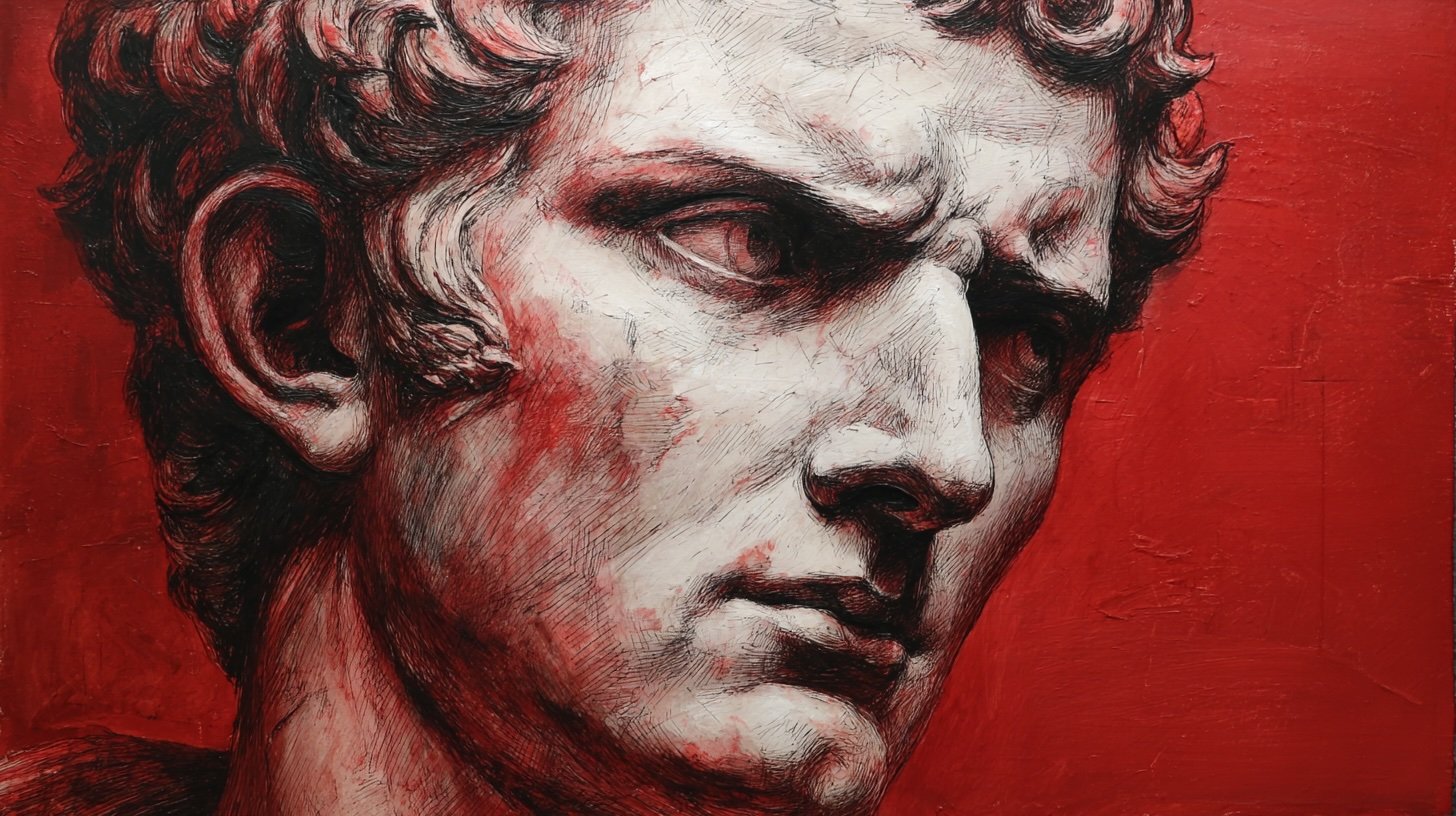
There is something almost too convenient about the way history remembers Caligula. The mad emperor, the man who allegedly declared war on the sea, turned his palace into a brothel, and planned to make his horse a senator. It is a portrait so theatrical, so grotesque, that it feels less like history and more like satire written centuries too late. Yet when you step back from the anecdotes and look at the structure of his rule, a different picture begins to form—one not of chaos, but of calculated performance.
Before the madness, there was popularity, and not the fragile, polite kind. When Caligula came to power in AD 37, he was greeted with something closer to collective relief. Rome had just endured the long, increasingly paranoid reign of Tiberius, whose later years were marked by treason trials, quiet purges, and an atmosphere that rewarded silence over loyalty. Caligula arrived as the opposite of that mood. He was young, charismatic, and, crucially, the son of Germanicus, a general whose reputation bordered on myth. The public did not merely accept him; they wanted him.
He understood the assignment immediately. In those early months, he cancelled certain taxes, recalled exiles, and funded lavish public games. Crowds cheered, the Senate cooperated, and for a brief moment the machinery of Rome appeared to run without friction. It is tempting to see this as a “before” picture, a calm preceding the storm, but that interpretation assumes what comes next is irrational. It also ignores the fact that Caligula had already spent years learning how power really worked.
His childhood unfolded under the watchful and often dangerous court of Tiberius. Family members disappeared, alliances shifted overnight, and survival depended less on truth than on performance. Knowing when to speak, when to flatter, and when to vanish into the background was not a political skill; it was a necessity. By the time Caligula reached adulthood, he had absorbed a system in which appearances mattered as much as actions, and sometimes more.
Then came the famous illness. Only months into his reign, he fell severely sick, and Rome braced for the possibility that its new favourite might die as suddenly as he had risen. According to later accounts, when he recovered, he was no longer the same man. This is the moment historians often circle, the supposed turning point where a benevolent ruler became unstable. It is a neat story, almost suspiciously neat, because it offers a clean explanation for behaviour that might otherwise require a more uncomfortable interpretation.
If the shift was not a collapse but a recalibration, the pattern of his actions begins to look different. What follows his recovery is not random chaos but targeted disruption, particularly aimed at the Senate. Caligula did not simply exercise authority; he staged it. He turned governance into something visible, repeatable, and, crucially, humiliating for those who believed themselves untouchable.
Senators were made to run alongside his chariot during public events, stripped of the dignity that normally insulated them from ridicule. Others were forced to attend spectacles they could not escape, sometimes witnessing executions at close range, denied even the courtesy of turning away. These were not private punishments carried out in the shadows. They were carefully constructed scenes, played out in front of an audience that could not miss the point. The hierarchy of Rome was being rewritten in real time.
He did not need to dismantle the Senate institutionally; he only needed to hollow it out symbolically. Once the public saw senators reduced to props in the emperor’s theatre, their authority lost its weight. It is difficult to command respect when you have already been turned into part of the entertainment.
The same theatrical logic extends to his most controversial claims, including his insistence on divine status. Declaring oneself a living god is often framed as the clearest evidence of madness, yet Roman rulers had long been edging toward deification after death. Caligula’s move was less a break from tradition than an acceleration of it. By demanding worship during his lifetime, he removed the final layer of pretence. Power was no longer cloaked in ritual modesty; it was presented as absolute and immediate.
That shift carried a practical advantage. If the emperor is divine, opposition becomes more than political disagreement. It becomes sacrilege. The boundaries of acceptable dissent shrink dramatically when they are defined in religious terms rather than civic ones.
His spectacles, often dismissed as extravagant excess, follow the same pattern. The construction of a floating bridge across the Bay of Baiae, for instance, is usually described as a vanity project or a delusional stunt. Yet the story behind it suggests something more deliberate. A prophecy had claimed he had no more chance of becoming emperor than of riding across the sea. By building the bridge and doing exactly that, he transformed a narrative about impossibility into a public demonstration of control. What was once a limit became a performance.
Even the infamous tale of Incitatus, his horse, fits comfortably into this framework. Whether Caligula seriously intended to appoint the animal to high office matters less than the message the story conveys. If a horse could be elevated to such a position, what did that imply about the men who currently held it? The joke lands precisely because it is aimed at the Senate’s sense of importance. It reduces political office to something arbitrary, even absurd.
This is where the idea of Caligula as a purely irrational figure begins to falter. His actions, taken individually, appear bizarre. Taken together, they reveal a consistent approach to power that relies on visibility, provocation, and control of narrative. He did not abandon the political system; he exposed its theatrical foundations and pushed them further than anyone before him.
Our understanding of all this, however, comes heavily filtered through writers like Suetonius, whose accounts were composed decades after Caligula’s death. These authors wrote from within a senatorial culture that had little reason to portray him sympathetically. For them, depicting Caligula as insane was not merely descriptive; it was useful. It allowed them to explain their own loss of dignity without confronting the possibility that their authority had been deliberately undermined.
Madness is a convenient explanation because it simplifies everything. It turns political conflict into personal failure. It suggests that the system itself remained sound, and only the individual at the top was flawed. Once that individual is removed, order can be restored, and the narrative closes neatly.
Yet the persistence of Caligula’s reputation raises a more complicated possibility. Perhaps he was not uniquely deranged, but unusually explicit. Where other emperors maintained the illusion that power was guided by tradition and restraint, Caligula made its performative nature impossible to ignore. He did not invent the theatre of Roman politics; he stripped away the curtains.
That exposure may have been his most dangerous act. A system built on appearances depends on those appearances remaining credible. Once they are revealed as staged, their authority weakens. Caligula’s reign, with all its excess and provocation, forced Rome to confront the mechanics of its own power structures in a way that was deeply uncomfortable.
His assassination in AD 41 provided a convenient resolution. Members of his own guard removed him, the Senate regained a sense of dignity, and the story of the mad emperor was cemented into history. It offered closure, reassurance, and a return to familiar narratives.
Even so, the question refuses to disappear. Was Caligula truly a ruler consumed by irrational impulses, or was he a political performer who understood that power in Rome was always a kind of theatre, and simply chose to take control of the stage?