Aztecs: The Brilliant and Brutal Lake Empire
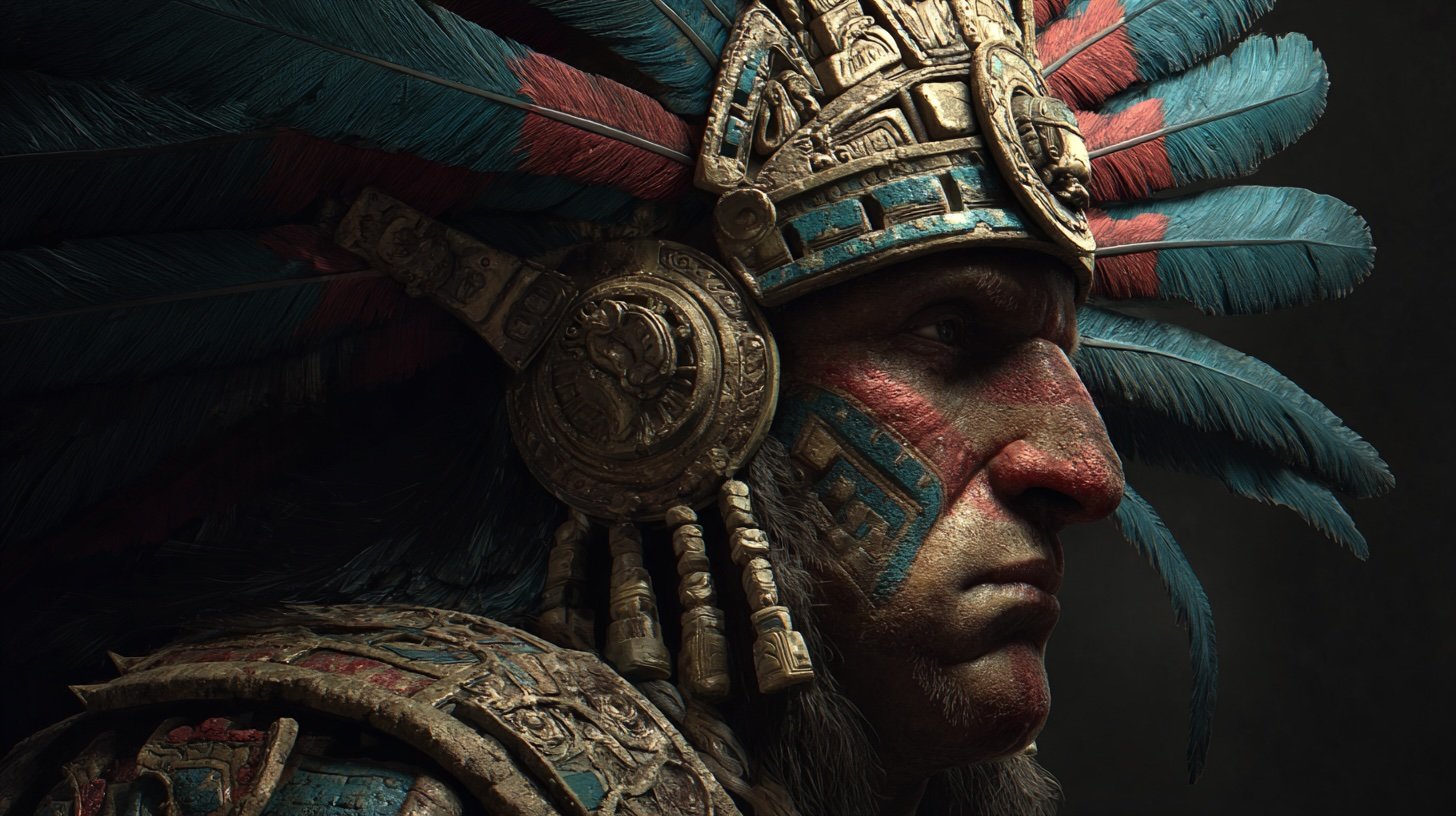
Not the cinematic kind with slow motion and violins. More the steady, everyday sound of water nudging stone steps, canoes brushing past reed edges, and someone swearing softly because a basket of chillies just tipped into the canal. This was Tenochtitlan, capital of the Mexica people, sitting right in the middle of Lake Texcoco and absolutely refusing to behave like a humble island settlement. By the early sixteenth century it had become one of the largest, most organised cities on the planet, built on water, powered by food systems that made European visitors blink twice, and wrapped in rituals that still make people uncomfortable centuries later.
We usually call them the Aztecs, which works fine as shorthand but misses some nuance. The people who ran this city called themselves the Mexica. Their empire did not operate as a single monolithic state but as a Triple Alliance between three city-states: Tenochtitlan, Texcoco, and Tlacopan. Think less Roman Empire with uniform administration and more a hard-nosed political partnership held together by shared interests, military muscle, and a very efficient tribute pipeline.
The awkwardly short lifespan of that empire often surprises people. The Triple Alliance formed in 1428. The Spanish captured Tenochtitlan in August 1521. That is not deep prehistory. That is closer to Henry VIII than to Stonehenge. The Aztecs did not rise, flourish, and fade over millennia. They sprinted.
Their origin story starts with wandering. Mexica tradition spoke of Aztlan, a homeland somewhere to the north, half real and half symbolic. Whether it existed as a physical place matters less than how the story worked. It explained why the Mexica arrived late to the Valley of Mexico, why they lacked powerful allies at first, and why divine favour mattered so much to their political identity. Even the name “Aztec” nods back to that mythic place, which later historians found easier to use than “Mexica with a complicated alliance structure”.
When the Mexica reached the valley, they found it crowded. City-states ringed the lakes, each with its own rulers, gods, and grudges. The Mexica settled on a marshy island that nobody else particularly wanted. Then they engineered it into something extraordinary.
Building a capital on a lake sounds like a terrible idea until you realise how seriously they took infrastructure. Causeways connected the island to the mainland. Canals ran through neighbourhoods. Aqueducts carried fresh water. This was not a soggy shanty town but a planned city where movement, trade, and ritual followed clear patterns.
The chinampa system still causes confusion because people insist on calling them floating gardens. They did not float. Farmers created them by staking out rectangles in shallow lake beds, layering mud, vegetation, and organic waste, then anchoring the plots with trees. Canals ran between the beds, allowing constant irrigation and canoe access. The result produced astonishing yields. Maize, beans, squash, chillies, flowers, and herbs grew in dense rotation, right next to the city that needed them.
That matters when people argue about population size. Numbers for Tenochtitlan range widely, and scholars still debate them. Estimates often land somewhere between 150,000 and 250,000 people, which already puts the city among the giants of its time. Higher figures circulate, usually drawn from enthusiastic early Spanish descriptions. Sensible historians treat those with caution. What nobody disputes is scale. This was a major urban centre with systems designed to feed, move, and control a very large population.
Markets anchored daily life. The market at Tlatelolco impressed even hardened conquistadors, who described thousands of traders, regulated prices, and officials settling disputes. A city that can organise commerce at that level does not run on improvisation or superstition. It runs on rules, enforcement, and habits learned over generations.
The empire itself expanded after 1428, when the Mexica joined forces with Texcoco and Tlacopan to overthrow a dominant rival. Expansion did not always mean annexation. Often it meant forcing local rulers into tribute arrangements. Conquered provinces sent goods to the capital according to detailed schedules. Nearby regions supplied bulk foodstuffs. Distant ones paid with high-value items such as feathers, cacao, and textiles that travelled well.
Lists of these payments survive, recorded in documents like the Codex Mendoza. They read less like epic poetry and more like a logistics spreadsheet. Empire, in practice, meant keeping goods moving and punishments credible.
Trade networks extended far beyond imperial borders. Obsidian, the razor-sharp volcanic glass used for tools and weapons, came from multiple sources. Recent scientific analysis of obsidian artefacts from the Templo Mayor shows connections reaching across central Mexico. Control of obsidian meant control of technology in a world without metal blades. It shaped warfare, ritual, and everyday labour.
Aztec warfare followed its own logic. Battles secured tribute, punished rebellion, and captured prisoners. Some conflicts, often labelled “flower wars”, appear to have functioned as ritualised fighting between rival states. These encounters reinforced military skill and fed religious needs without total conquest. They also kept old enemies alive and resentful.
That resentment helps explain why the Spanish did not conquer the Aztec Empire alone. When Hernán Cortés arrived in 1519, he stepped into an existing web of rivalries. Tlaxcala, a long-standing enemy of the Mexica, allied with the newcomers. Other groups joined for their own reasons. The conquest became a coalition war, not a simple clash between Europe and the Americas.
Disease added another layer of chaos. Epidemics tore through populations with no prior exposure, weakening resistance and amplifying fear. Disease did not replace politics or warfare. It intensified them.
Aztec cosmology linked the survival of the world to human action. Gods required nourishment. Time moved in cycles that demanded ritual upkeep. The Templo Mayor stood at the centre of this system, both physically and symbolically. Twin stairways climbed to shrines dedicated to Huitzilopochtli, god of war and the sun, and Tlaloc, god of rain. The pairing itself tells a story. Crops and conquest mattered equally.
Human sacrifice remains the most controversial aspect of Aztec society, and for good reason. Colonial sources describe mass sacrifices in numbers that strain credibility. The most infamous claim speaks of more than eighty thousand victims over four days during a temple reconsecration in 1487. Logistically, that figure collapses under scrutiny. Even critics of Aztec ritual violence question whether such numbers could physically occur within the described time and space.
Other scholars argue for much lower totals, sometimes in the thousands annually rather than tens of thousands. Archaeology confirms sacrifice through human remains, skull racks, and ritual deposits, but it does not provide a neat annual count. Practices likely varied by festival, political moment, and region.
Recent excavations near the Templo Mayor uncovered parts of the Huey Tzompantli, a skull tower built from the remains of sacrificed individuals. The structure contained hundreds of skulls, including women and children, which complicated earlier assumptions that sacrifices involved only captured male warriors. These finds reinforce the reality of ritual killing while also reminding us how selective the archaeological record can be.
Everyday life continued around farming, craft production, education, and family obligations. Social classes shaped expectations. Nobles trained for leadership and ritual roles. Commoners farmed, traded, and served in armies. Slavery existed but differed from later Atlantic models; enslaved people retained certain rights and pathways out of bondage.
Education mattered. Boys and girls attended schools that taught history, morality, religion, and practical skills. Discipline could be severe, but the existence of formal schooling itself speaks to how seriously the Mexica took social continuity.
Women played essential roles in household economies, textile production, and market trade. Midwives held respected positions. Daily survival depended less on dramatic rituals than on grinding consistency.
One refuses to die: the idea that Moctezuma believed Cortés was the returning god Quetzalcoatl. Modern historians treat this with deep scepticism. The story appears most clearly in Spanish accounts written after the conquest. It frames defeat as destiny rather than the result of strategic miscalculation, coercion, and betrayal. Moctezuma may have hesitated. He did not mistake armed strangers for divine beings strolling out of legend.
Another myth paints the Aztecs as uniquely cruel. Human sacrifice shocks, but ritual violence did not exist in a vacuum. European societies of the same period practised public executions, religious persecution, and brutal warfare. Shock often reflects unfamiliarity rather than objective comparison.
Romantic counter-myths swing too far in the opposite direction, portraying the Aztecs as misunderstood pacifists undone by European treachery alone. That erases their imperial ambitions and the very real suffering imposed on subject peoples.
The Aztec Empire thrived because it combined engineering skill, agricultural innovation, political alliances, military pressure, and religious theatre into a single system. It fell because that system met external invasion at a moment of internal tension, epidemic collapse, and regional hostility.
When Tenochtitlan fell on 13 August 1521, the city did not vanish overnight. Spaniards dismantled temples and reused stones. Mexico City rose on top of the ruins. Lake Texcoco gradually disappeared. Yet traces keep resurfacing whenever the modern city digs deep enough.
New research continues to refine our understanding. Scientific analysis of materials like obsidian maps networks invisible in written sources. Ongoing excavations at the Templo Mayor reveal offerings that connect distant regions, rare animals, and symbolic objects into coherent ritual programmes. Each find complicates easy narratives.
The Aztecs do not fit neatly into hero or villain categories. They built fast, ruled hard, believed deeply, and left behind a legacy that still unsettles and fascinates. History does not ask us to be comfortable. It asks us to pay attention.