Assyrian Complaints: People Always Loved a Good Moan
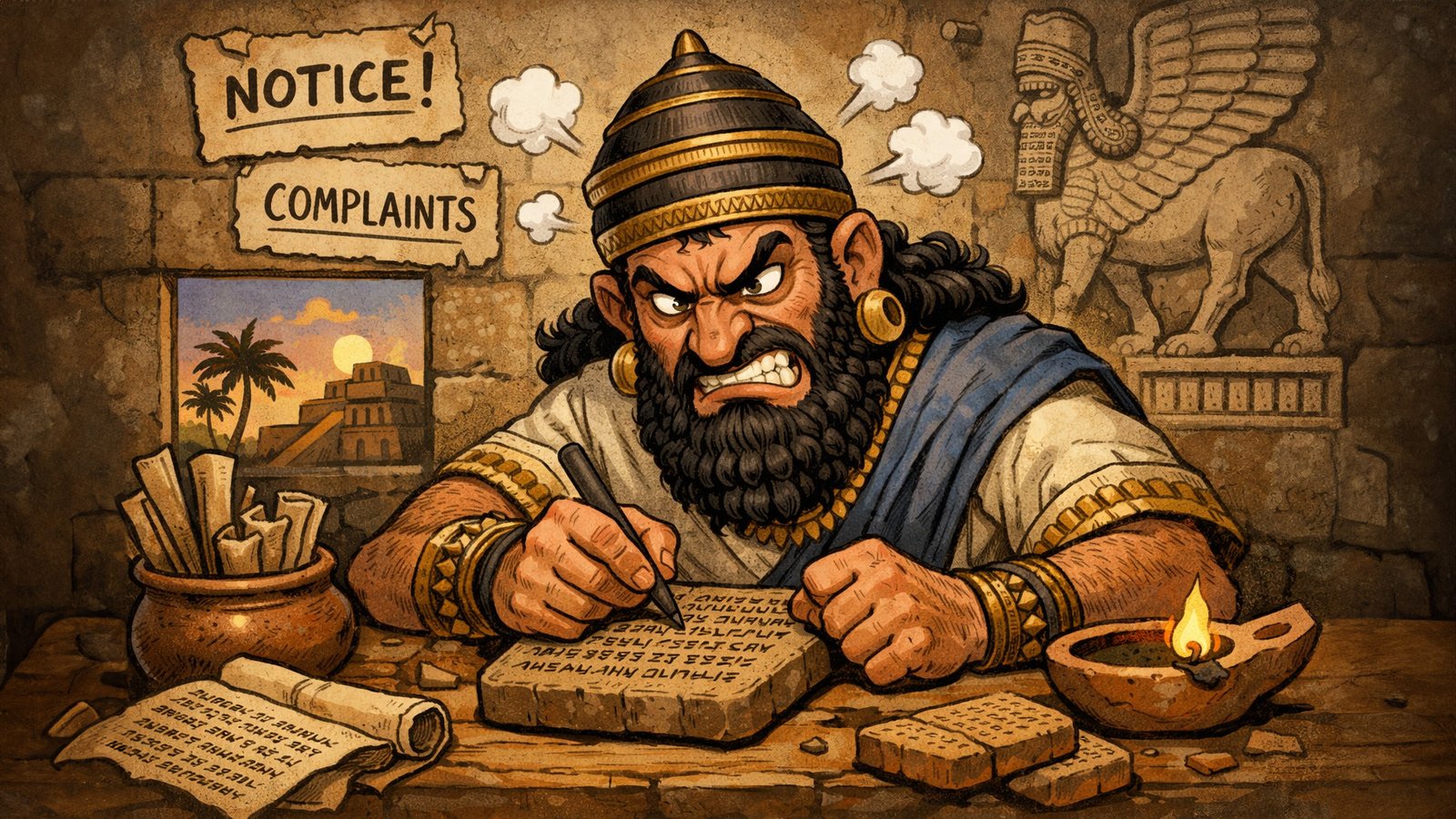
When you think about ancient Assyria, what springs to mind? Mighty conquering armies, perhaps? Towering ziggurats piercing the Mesopotamian sky? Brutal kings with impressively elaborate beards that could house entire civilizations of wildlife? You’re not wrong. However, tucked between all that empire-building lies something wonderfully human. Thousands of clay tablets absolutely covered in relatable moaning from people who lived nearly four thousand years ago. Turns out, complaining is humanity’s true timeless art form.
Somewhere around 1750 BCE, a merchant named Nanni was having a spectacularly terrible day. Apparently, it was more like a spectacularly terrible month. He’d sent payment for copper ingots to a dealer called Ea-nāṣir. Surprisingly, what arrived was the Bronze Age equivalent of ordering a smartphone online and receiving a potato. Not only was the copper substandard, but Ea-nāṣir had the audacity to treat Nanni’s messenger like dirt. The poor fellow had merely tried to sort things out. Naturally, Nanni did what any sensible person would do. He grabbed a clay tablet and carved out what is essentially the world’s first one-star review.
The tablet was discovered in what archaeologists believe was Ea-nāṣir’s house. Interestingly, it’s deliciously passive-aggressive. Nanni writes about delivering copper to the palace on Ea-nāṣir’s behalf. Clearly, he was a good customer. Furthermore, he mentions his messenger was a “gentleman” of similar social standing. Obviously, this made Ea-nāṣir’s dismissive treatment all the more insulting. The kicker? Remarkably, Nanni hadn’t even accepted the dodgy copper yet. He’d paid for it, certainly. Nevertheless, he was making absolutely sure Ea-nāṣir knew he wasn’t having any of it.
What makes this story absolutely brilliant is simple. Apparently, Ea-nāṣir kept his hate mail. Like some sort of ancient masochist with a filing system. Archaeologists found multiple complaint tablets in his house. Not just Nanni’s, either. A chap named Imgur-Sin wrote begging for decent copper. Indeed, he added the wonderfully weary line: “Do you not know that I am weary?” It’s the 18th century BCE equivalent of “I’m too tired for this nonsense.” Similarly, another trader, Nar-am, specifically requested “very good copper.” The subtext being: “Please, for the love of all the gods, just send me copper that’s actually copper.” Evidently, this suggests Ea-nāṣir’s reputation for flogging inferior goods was common knowledge around Ur. Essentially, the man was the ancient world’s most spectacularly unreliable tradesman. His complaint archive reads like a Bronze Age TripAdvisor page where every review is one star and mentions rats.
Moving from dodgy business deals to family drama, we find another absolute gem. This one’s from around 1800 BCE. Young Iddin-Sin was away at boarding school, probably. Unsurprisingly, he had strong opinions about his wardrobe. Actually, he had strong opinions about his mother’s catastrophic failures at making his wardrobe. Predictably, the letter he sent home is a masterclass in teenage guilt-tripping that would make any modern parent’s eye twitch violently. It’s so relatable it hurts.
Iddin-Sin complained bitterly about the clothes his mother had lovingly woven. Frankly, they were embarrassing compared to what his mates were wearing. To really twist the knife—and young Iddin-Sin clearly had a future in emotional warfare—he pointed out something brutal. Even the adopted son of one of his father’s servants had better gear. The adopted son of a servant. Let that sink in. Obviously, the fashion-conscious student was mortified beyond belief. What makes this particularly hilarious is that making these clothes was no small feat.
Typically, weaving a standard textile could take three months of full-time work. Initially, Iddin-Sin’s mother would have bought the wool at market. Then she’d spend months spinning it, dyeing it, and tailoring it with her own hands. Potentially, the process could take up to a year for finer garments. Nevertheless, her son was having absolutely none of it if it didn’t meet his exacting social standards. Poor woman probably considered posting him back to the school in a sack.
Historians love this letter because it proves, beyond any doubt, that teenagers complaining about not having the right trainers is truly a timeless human experience. Nothing has changed. The specifics might differ—tunics versus hoodies—but the underlying desperation to fit in with one’s peers remains exactly the same across millennia.
Family tensions didn’t stop at wardrobe complaints, either. Around 680 BCE, an Assyrian princess named Šeru’a-eṭirat took time out of her undoubtedly busy day of being royal. She wrote a letter to her sister-in-law, the future queen Libbali-šarrat. The topic? Homework. Specifically, the shocking lack of homework being done. Clearly, the princess was not impressed that the future queen wasn’t applying herself. Reading and writing exercises were being spectacularly neglected. Eventually, she wrote what amounts to: “Why don’t you write your tablet and do your homework? If you don’t, they will say: ‘Is this the sister of Šeru’a-eṭirat, the eldest daughter of the great king?'” Which is fancy ancient speak for “You’re making me look bad.”
Consequently, even in royal palaces where someone else fetched your water, cooked your meals, and probably brushed your hair, someone still had to nag about homework. Servants handled every mundane task, yet this remained. The letter reveals something rather progressive for the time. Women in the Assyrian royal family were expected to be literate. Moreover, the princess’s gentle chiding shows she understood delicate power dynamics. She outranked her sister-in-law, true. But the younger woman was married to the crown prince. He would eventually outrank them both. So it’s less “do your homework or else” and more “do your homework or you’ll embarrass us both and then what?”
Beyond individual complaints, the merchants’ letters paint a vivid picture. Around 1900 BCE, traders operated between Assur and Kaneš in modern Turkey. Constantly, they were writing to chase payments. Complaints about delayed shipments filled their correspondence. Grumbles about the dangers their caravans faced were common. One particularly exasperated letter survives from Silla-Labbum and Elani to Puzur-Assur. It notes that thirty years had passed without so much as a deposit of silver. “We have never made you feel bad about this,” they write, clearly lying through their teeth. One imagines considerable restraint. “But we are now forced to appear, in your eyes, acting as gentlemen.” Translation: “We’ve been incredibly patient but we’d quite like our money now, you absolute weapon.”
These merchants travelled vast distances by donkey caravan. They often lived separately from their families for years. Accordingly, the letters reveal deep homesickness alongside business concerns. Women wrote from Assur about managing households alone. They dealt with textile production quotas. They consulted dream interpreters about their absent husbands’ safety. In one letter, two sisters wrote to their brother chiding him for neglecting his religious duties. “Ashur keeps warning you,” they wrote. “You love money so much that you despise your own life!” Which is the ancient equivalent of “Mate, seriously, you need to sort out your priorities.”
The letters women wrote during this period are particularly revealing. Assyrian society was undeniably patriarchal, true. But the tablets show women stepping into significant roles when their husbands were away. Managing finances became their responsibility. Supervising workers fell to them. Making business decisions was their domain. Writing in their own hands rather than dictating to scribes demonstrated their literacy. One furious mother and father wrote to their daughter Zizizi. She had married a local man in Kaneš after her first husband died. Understandably, they accused her of abandoning the family. “Before god, you do not treat me, your father, like a gentleman! You have left the family!”
What these tablets reveal is brilliantly simple. Human nature hasn’t shifted a jot in four thousand years. People got angry about shoddy workmanship. Teenagers wanted fashionable clothes. Parents nagged relentlessly about homework. Merchants chased debts with increasingly passive-aggressive correspondence. Families argued about money and loyalty. Business rivals spread vicious gossip about each other’s reputations. People worried themselves sick about their loved ones travelling dangerous routes. In short, the Assyrians were exactly like us. They simply pressed their grievances into wet clay rather than firing off angry tweets at 2am.
There’s something profoundly moving about these tablets. Generally, when we think of ancient civilizations, we often imagine them as somehow different from us. More stoic, perhaps, or more concerned with grand matters of state and religion. However, these letters remind us that most people, most of the time, were worried about exactly the same things that occupy our thoughts today. Making a living, maintaining relationships, protecting their reputations, and ensuring their children had decent prospects.
The famous “grumbling Assyrian tablet” that supposedly complained about children not obeying their parents and everyone wanting to write a book? That’s actually a myth—no such tablet exists. Disappointing, I know. Nevertheless, the myth persists precisely because it feels so perfectly plausible. We desperately want to believe the Assyrians complained about the same things Victorian grandparents moaned about, which our grandparents grumbled about, which we’re definitely whinging about right now on social media. “Kids today!” has been the rallying cry of every generation since someone first etched it in cuneiform.
What makes these genuine tablets even better than the mythical one is their specificity. Essentially, we don’t just know that Assyrians got cross with bad service. We know exactly what Nanni said to Ea-nāṣir about his rubbish copper. Similarly, we don’t just know parents worried about their children’s education. We can read the exact words a princess used to guilt-trip her sister-in-law about skipping homework. Ultimately, these details breathe life into a civilisation that fell over two and a half thousand years ago.
The preservation of these complaints is itself rather wonderful. Clay tablets became incredibly durable after baking. Sometimes this happened deliberately. Other times it happened accidentally in fires that destroyed the buildings. Consequently, the very destruction of Assyrian cities—which was undoubtedly terrible for everyone involved—helped preserve the mundane complaints of their inhabitants. Modern archaeologists could then unearth them thousands of years later. Ea-nāṣir’s house fire probably ruined his day considerably. Ultimately, it immortalised his spectacularly terrible customer service record for all eternity. He’s more famous now for being rubbish at his job than most kings are for their conquests. There’s a certain poetic justice in that.
Perhaps the greatest irony is this. Assyrian kings commissioned elaborate inscriptions. These boasted of their military conquests and divine favour. The texts were designed to ensure their eternal glory. Yet it’s the petty grievances of ordinary people that truly bring their world to life. Ea-nāṣir is remembered not because he built any temples. He didn’t conquer any cities. Rather, he’s famous because he consistently delivered substandard copper and kept the complaint letters. Iddin-Sin isn’t remembered for any notable achievements. Instead, we recall him because he whined about his clothes with the timeless indignation of embarrassed youth.
These tablets transform our understanding of the ancient world. Instead of distant, inscrutable ancients, the Assyrians emerge as recognisable humans. The same petty annoyances that fill our own lives filled theirs too. The same domestic dramas we face troubled them as well. Their lives weren’t so different from ours, really. Better clay tablet archiving systems, certainly. Oh, and considerably more impressive beards.
The next time you’re tempted to fire off an angry email about a delayed delivery or defective product, spare a thought for Nanni. His complaint has survived nearly four thousand years and become an internet meme. Yours will probably just disappear into the digital ether, deleted by some poor customer service representative who’ll never remember your name. Then again, Nanni’s complaint didn’t actually get him his money back, did it? And Ea-nāṣir presumably carried on flogging dodgy copper to anyone gullible enough to buy it. So perhaps the most ancient truth of all is this: complaining is deeply satisfying, rarely effective, and absolutely eternal. We’ve been at it for four millennia and show no signs of stopping. At least Nanni’s whinging got immortalised. Yours will just clog up someone’s inbox before being archived into oblivion. Make it count.