Aliens: They’re There, Just Not Talking to Us
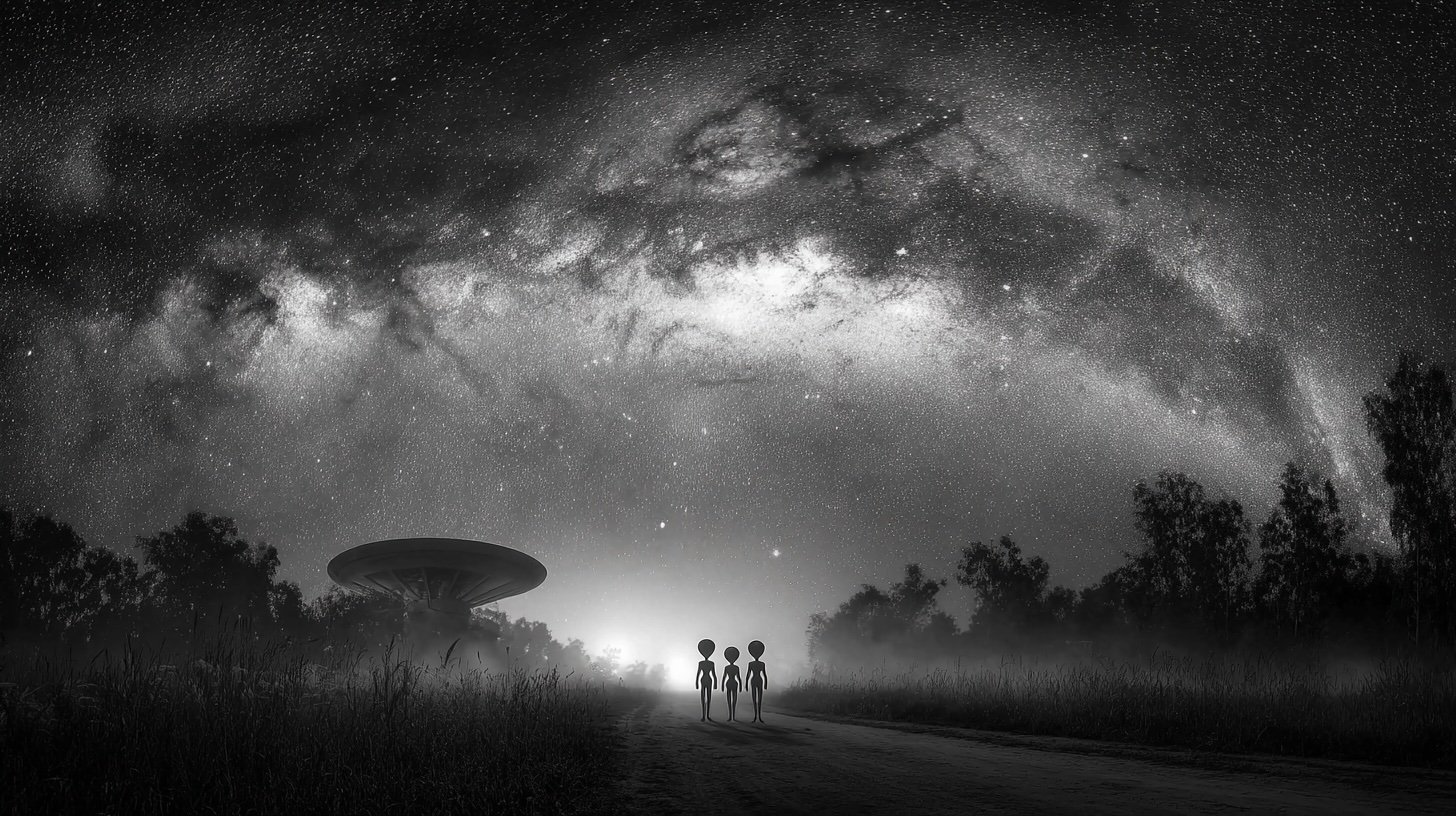
The universe has a talent for raising expectations and then refusing to follow through. For decades now, it has looked increasingly crowded. Telescopes peer deeper, catalogues grow thicker, and astronomers speak casually about billions of galaxies as if they were items on a supermarket shelf. As a result, planets no longer feel rare or precious. Instead, they feel inevitable. Somewhere in that sprawl, common sense whispers that someone else should be out there.
And yet the universe remains stubbornly quiet. Not even rude. Just silent. That silence did not start as a philosophical problem. Rather, it began as a practical one. In the middle of the twentieth century, scientists realised that the ingredients for life were not exotic at all. Carbon turned up everywhere. Water vapour drifted through interstellar clouds. Meanwhile, energy flowed freely. Chemistry, it seemed, wanted to get interesting. As astronomy matured, optimism followed. Consequently, the Milky Way stopped looking lonely and started resembling a packed housing estate.
By the time the first exoplanets were confirmed in the 1990s, the tone had shifted decisively. Planets were not rare accidents. Instead, they were standard equipment. Stars formed them the way trees produced leaves. Moreover, some of those worlds sat at comfortable distances from their suns, neither boiling nor frozen, neither stripped bare nor crushed under gas. If life had emerged here, on a wet rock circling an unremarkable star, why would it not have done the same elsewhere?
That confidence, however, made the quiet more awkward. The question itself arrived casually, as awkward questions often do. During a lunchtime conversation in 1950, Enrico Fermi reportedly paused mid-chat and asked a simple thing: where is everybody? He did not mean microbes or chemistry. Instead, he meant neighbours. Builders. Engineers. Anyone who might have left a mark. Given enough time, a technologically capable civilisation could spread across a galaxy. Given enough civilisations, the sky should look busy.
Instead, it looks like this. Astronomy offers no shortage of distractions. Nebulae glow theatrically. Black holes behave badly. Stars explode with admirable commitment. Yet through all that spectacle, no clear sign of intelligent company appears. There are no megastructures. No unmistakable signals. No cosmic graffiti. Over time, the silence has become conspicuous.
Attempts to put numbers on the problem followed soon after. In 1961, Frank Drake introduced an equation designed less to deliver answers than to organise ignorance. It multiplied hopeful terms together: stars forming each year, planets per star, habitable worlds, life emerging, intelligence evolving, technology developing, civilisations lasting. Depending on optimism, the final result swung wildly. The important point, however, sat elsewhere. Somewhere along that chain, something might fail.
For a while, the failure felt safely behind us. Life, people assumed, must be the hard part. Once it started, intelligence and technology would follow naturally. As more planets appeared in surveys, that assumption began to creak. Microbes might be common. Civilisations, perhaps not.
Gradually, this idea hardened into what became known as the Great Filter. The filter represents a step so unlikely that almost everything fails to pass it. It could sit early. Maybe life itself barely ever begins. Or it could sit later. Perhaps intelligence arises only briefly before snuffing itself out. Nuclear war, ecological collapse, runaway technology, or simple boredom all make the list easily.
The position of that filter matters more than its nature. If it lies behind us, humanity looks special and improbably lucky. If it lies ahead, the silence starts to sound like a warning.
Other explanations soften the drama without solving the puzzle. Perhaps civilisations do not shout into the void. Humans have broadcast radio for just over a century, which is a cosmic eye blink. Already, communication on Earth shifts towards quieter, tighter beams. Fibre optics replaced broadcast noise. Encryption replaced openness. A civilisation a thousand years older might therefore be almost undetectable, efficient to the point of invisibility.
There is also the possibility that we are listening badly. Humans search for patterns they recognise. Narrow-band radio signals. Repeating pulses. Clear mathematical structures. Another intelligence might choose methods that feel obvious to them and invisible to us. After all, whale songs baffled humans for centuries. Alien communication could do the same on a larger scale.
Then there is the zoo. The zoo hypothesis suggests that advanced civilisations notice us, classify us, and then politely ignore us. Much as humans observe wildlife, they watch without interfering. The appeal is obvious. It flatters human importance while explaining silence. At the same time, it raises uncomfortable questions. Why would countless alien cultures share the same restraint? Who enforces it? And why begin observation precisely now, when our species has existed for barely a moment?
Sceptics, however, point out that this explanation smuggles human behaviour into alien minds. Curiosity, ethics, and non-interference may not travel well across biology.
The rare Earth argument pushes in the opposite direction. It suggests that while simple life may bloom easily, complex life demands a long list of favourable accidents. A stable star matters. A protective magnetic field matters. Plate tectonics recycling nutrients matter. A large moon calming a planet’s wobble matters. Remove one, and complexity struggles. Intelligence, in this view, becomes a fragile afterthought rather than a natural outcome.
This does not make Earth miraculous. Instead, it makes it specific. Meanwhile, people have been listening anyway. For decades, radio telescopes have scanned the sky, combing through static for anything that looks deliberate. The most famous moment came in 1977, when a powerful signal briefly appeared in the data from an Ohio telescope. It matched expectations. It came from the right part of the sky. Then it vanished. It never returned. The note scribbled beside it read simply “Wow”. The name stuck. The explanation did not.
Silence, punctured briefly, then restored. Outside laboratories, the quiet has never stopped speculation. Ancient myths get reread. Gods arrive from the sky. Fire descends from above. Chariots fly. Modern eyes see visitors where earlier ones saw metaphors. Archaeologists remain unimpressed. Human societies, it turns out, can build remarkable things without extraterrestrial help. Often, the urge to credit aliens says more about modern doubt than ancient capability.
More recently, unidentified objects have returned to the spotlight under new labels. Military footage circulates. Congressional hearings convene. Some encounters resist easy explanation. Weather balloons and sensor errors explain many. A few remain stubbornly odd. Still, none demand aliens as an answer. Unidentified does not mean extraterrestrial. It means incomplete information, which is less glamorous.
Culturally, aliens have always mirrored their era. In the 1950s, they invaded. In the 1970s, they warned. In the 1990s, they abducted. Today, they observe silently, distant and unreadable. The shift feels telling. Modern fears revolve less around attack and more around neglect. Being ignored unsettles us more than being threatened.
Scientists themselves remain divided on whether the paradox deserves its name. Some argue that there is no paradox at all. The universe is vast. Civilisations may be rare and short-lived. Overlap may never occur. Expecting evidence could be like expecting two fireflies to collide in a stadium.
Others point to anthropic bias. We observe a quiet universe because only in such a universe could observers survive long enough to wonder about it. Loud universes might burn themselves out quickly. Silence, in that sense, becomes a prerequisite rather than a mystery.
There is also the uncomfortable possibility that intelligence does not naturally expand. Human history equates progress with growth. That assumption may be local. A civilisation might turn inward, prioritising stability over exploration. It might upload itself into environments we cannot detect. Or it might decide that shouting into the cosmos attracts the wrong kind of attention.
None of these ideas are comforting. None are easily disproved. What makes the silence powerful is not what it says about aliens, but what it reflects back at us. We are new, noisy, and impatient. We expect replies. We assume interest. We project motives outward. The universe offers no reassurance that any of this is shared.
Yet the search continues, quietly and methodically. Telescopes grow more sensitive. Surveys expand. New methods emerge, hunting for atmospheric fingerprints or artificial light on distant worlds. As a result, the question has matured. It now sounds less like a shout and more like a pause.
Aliens may exist in abundance. They may flourish, think, and wonder elsewhere. They may also remain forever out of reach, separated not by hostility but by time, technology, or indifference. The silence does not deny their existence. It denies us a conversation.
For now, the universe does not talk back. Instead, it simply keeps going, enormous and unconcerned, leaving us to listen to the quiet and decide what it means.